
Low Headroom vs. Standard Chain Hoist: Which Is Best for Your Space?
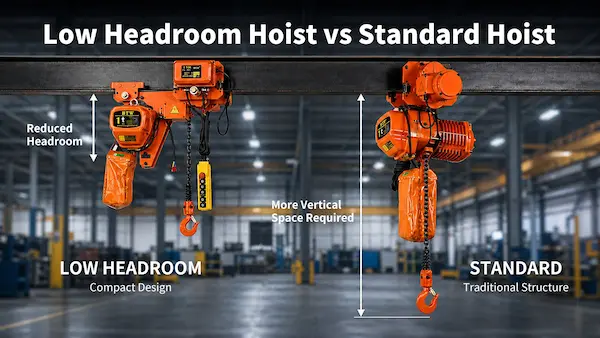
When overhead space is limited, choosing the right chain hoist can make a significant difference in how much usable lifting height you have. A low headroom chain hoist is designed to position the lifting point closer to the supporting beam, while a standard chain hoist typically requires more vertical space below the beam.
So, which option is right for your facility? The answer depends on your available headroom, required hook height, load capacity, installation conditions, lifting frequency, and budget. This guide compares low headroom vs. standard chain hoists and explains when each design makes the most sense.
What Is Headroom in a Chain Hoist?
In lifting equipment, headroom refers to the vertical distance occupied by the hoist and its suspension arrangement between the supporting structure and the lifting point. The available headroom affects how high a load can be lifted before the hook or hoist reaches the upper limit of travel.
This dimension becomes especially important in workshops, warehouses, manufacturing plants, and other facilities where the building height is limited or overhead structures, lighting, pipes, cranes, and other equipment restrict the available lifting space.
A lower-headroom configuration can help maximize usable hook height without requiring changes to the building structure.
What Is a Standard Chain Hoist?
A standard chain hoist is a conventional lifting configuration used across workshops, manufacturing facilities, warehouses, construction sites, and maintenance applications. Depending on the model, the hoist can be manually operated or electrically powered and may be suspended directly by a hook or installed with a trolley.
Standard chain hoists are a practical choice when sufficient overhead clearance is available. Their conventional configuration can provide a simple and versatile solution for general-purpose lifting without requiring a specialized low-clearance design.
- Suitable for general lifting applications
- Available in manual and electric configurations
- Can be used with fixed suspension or compatible trolleys
- Suitable where overhead clearance is not a major constraint
- Generally straightforward to install and maintain
What Is a Low Headroom Chain Hoist?
A low headroom chain hoist is designed specifically for applications where vertical space is limited. Its compact suspension and hoist arrangement allows the lifting point to be positioned closer to the supporting beam than with many conventional configurations.
The main advantage is not simply that the hoist is smaller. The important benefit is that the overall lifting arrangement uses less vertical space, allowing the available hook travel to be used more effectively.
This makes low headroom hoists particularly useful in workshops with low ceilings, buildings with overhead obstructions, and production areas where maximizing usable lifting height is important.
Low Headroom vs. Standard Chain Hoist: Key Differences
The main difference between the two designs is how efficiently they use the vertical space between the supporting structure and the lifting point. However, headroom is only one factor. Installation, application, capacity, lifting frequency, and budget should also be considered.
| Factor | Low Headroom Chain Hoist | Standard Chain Hoist |
|---|---|---|
| Vertical clearance | Designed to minimize the space required above the lifting point | Requires more vertical space depending on the suspension configuration |
| Hook height | Helps maximize usable hook height in restricted spaces | Suitable where available hook height is less restricted |
| Design | Compact and space-conscious configuration | Conventional hoist and suspension arrangement |
| Best suited for | Low-ceiling workshops and restricted-clearance applications | General-purpose lifting with sufficient overhead clearance |
| Installation | May require more careful consideration of beam and trolley configuration | Generally straightforward with compatible suspension equipment |
| Space efficiency | High | Standard |
| Initial cost | May be higher because of the specialized compact design | Often more economical for general-purpose applications |
1. Design and Mechanical Layout
In a conventional arrangement, the hoist and suspension components occupy vertical space below the supporting beam. Depending on the trolley and hoist design, this can reduce the available hook height.
A low headroom chain hoist uses a more compact arrangement to reduce the vertical space occupied by the lifting equipment. The exact construction varies by manufacturer and model, so the actual headroom dimension should always be checked against the product’s technical drawing before selection.
2. Space Efficiency and Hook Travel
This is usually the most important reason to choose a low headroom hoist.
If the ceiling, roof structure, crane runway, pipes, lighting, or other equipment limits the available vertical space, reducing the headroom of the hoist can provide more usable hook travel. In practical terms, this can allow loads to be lifted closer to the underside of the building structure.
For facilities where every part of the available lifting height matters, space-saving lifting equipment can improve the usefulness of the existing workspace without requiring major structural modifications.
3. Capacity and Lifting Configuration
Both standard and low headroom chain hoists are available in different capacities and configurations. The appropriate capacity depends on the maximum working load, lifting frequency, required lifting height, operating environment, and applicable safety requirements.
For frequent industrial lifting, an electric low headroom chain hoist can provide powered lifting while maintaining a compact installation arrangement.
When selecting a model, do not choose the hoist based on capacity alone. The overall dimensions, headroom, lifting height, beam configuration, power supply, control method, and working conditions should all be checked.
4. Installation Requirements
A standard chain hoist can be relatively straightforward to install when the supporting structure and available clearance are suitable for the selected suspension arrangement.
A low headroom hoist requires more attention to the relationship between the hoist, trolley, beam, hook position, and surrounding structures. Before ordering, it is important to verify the beam dimensions and the available installation space against the manufacturer’s technical drawing.
5. Typical Applications
Standard chain hoists are commonly suitable for:
- General workshop lifting
- Manufacturing and fabrication areas
- Equipment maintenance
- Warehouse material handling
- Construction and repair applications
- Facilities with sufficient overhead clearance
Low headroom chain hoists are particularly useful for:
- Low-ceiling workshops
- Manufacturing areas with restricted overhead space
- Buildings with overhead pipes or structural obstructions
- Work areas where maximum hook height is important
- Material handling applications with limited vertical clearance
- Existing crane systems where increasing building height is not practical
Pros and Cons: Low Headroom vs. Standard Chain Hoist
Standard Chain Hoist
Advantages
- Practical for general-purpose lifting
- Conventional and familiar installation arrangement
- Available in a wide range of capacities and configurations
- Suitable where overhead clearance is sufficient
- Can be a cost-effective option for standard applications
Limitations
- May use more vertical space
- Can reduce usable hook height in low-ceiling facilities
- May be unsuitable where overhead clearance is severely restricted
Low Headroom Chain Hoist
Advantages
- Designed for restricted vertical clearance
- Helps maximize usable hook height
- Efficient use of existing overhead space
- Well suited to low-ceiling workshops and industrial facilities
- Can reduce the need for major structural changes to gain lifting height
Limitations
- May have a higher initial cost than a conventional configuration
- Requires careful checking of beam and installation dimensions
- Actual headroom performance varies by model and capacity
How to Choose the Right Hoist for Limited Clearance
If you are selecting lifting equipment for a low-ceiling workshop or restricted installation area, use the following checklist before requesting a quotation.
1. Measure the Available Vertical Space
Measure the distance between the supporting structure and the maximum height required for the load. Do not estimate this dimension from the building height alone.
2. Determine the Required Lifting Height
Identify how high the load actually needs to be lifted during normal operation. A higher required hook position makes headroom more important.
3. Confirm the Required Capacity
Determine the maximum working load and select a suitable rated capacity. Consider the actual load, lifting method, duty cycle, and applicable safety requirements.
4. Check the Beam and Trolley Configuration
Confirm the supporting beam type and dimensions, trolley compatibility, flange width, and available installation space. These details are especially important for low headroom applications.
5. Consider Manual vs. Electric Operation
For occasional maintenance work, a manual chain hoist may be sufficient. For frequent production or material-handling operations, an electric chain hoist may provide more efficient and consistent lifting.
Low Headroom Chain Hoist or Standard Chain Hoist: Which Should You Choose?
The simplest way to make the decision is to start with your available headroom rather than the hoist price.
Choose a Standard Chain Hoist If:
- Your facility has sufficient overhead clearance.
- Maximum hook height is not a major limitation.
- You need a general-purpose lifting solution.
- A conventional installation arrangement meets your requirements.
- Keeping the initial equipment cost lower is an important consideration.
Choose a Low Headroom Chain Hoist If:
- Your workshop or facility has limited ceiling height.
- You need to maximize usable hook height.
- Overhead structures or equipment restrict the available lifting space.
- Replacing or modifying the building structure is impractical.
- Space efficiency is more important than selecting the simplest conventional configuration.
Why Low Headroom Matters in Industrial Lifting
In a high-clearance building, the difference between hoist configurations may have little practical impact. In a low-ceiling workshop, however, the available headroom can determine whether a load can be lifted to the required working height.
This is why low headroom lifting equipment is often selected not because it has a fundamentally different lifting purpose, but because it makes better use of the vertical space that already exists.
The right solution therefore depends on the relationship between the building structure, the hoist dimensions, the required hook height, and the load being handled.
Low Headroom Electric Chain Hoists from KYLIFT
If your application requires maximum hook height in a restricted installation area, explore the KYLIFT Low Headroom Electric Chain Hoist.
Before selecting a model, our team can review your required capacity, lifting height, available headroom, beam dimensions, power supply, and application conditions to help identify a suitable configuration.
Need Help Selecting a Low Headroom Hoist?
Send us your required lifting capacity, lifting height, available headroom, beam dimensions, and operating conditions. The KYLIFT team can help you check the appropriate hoist configuration and provide product dimensions and a factory-direct quotation.
Request a Low Headroom Hoist Quote