How to Choose a Lever Hoist: A Complete Buyer’s Guide (2026)
Capacity • Lift Height • Chain Length • Working Environment • Safety Tips
Find the Right Lever Hoist for Your JobWhat is a Lever Hoist?
A lever hoist (also widely known as a lever chain hoist or come-along puller) is a highly portable manual lifting and pulling device used extensively in heavy-duty industrial applications. Unlike traditional vertical-only lifting equipment, a lever block is incredibly versatile because it can pull, lift, and tension loads at almost any angle—including horizontal configurations.
How Does a Lever Hoist Work?
The operating principle of a lever hoist is straightforward yet mechanically robust. By cranking the handle (lever) up and down, the operator engages a mechanical ratchet and pawl system. This action rotates an internal pocket wheel that feeds the load chain, either drawing the hook closer to lift/tension the load or releasing the chain to lower it. An automatic friction brake operates under load, safely holding the tension when the operator stops cranking.
Because of this high mechanical advantage, an operator can effortlessly lift loads of up to several tons with minimal manual effort. This makes it a perfect, cost-effective alternative to heavy electric chain hoists in remote construction sites where power supply is unavailable or portability is highly prioritized.
Industries That Benefit Most from Lever Hoists
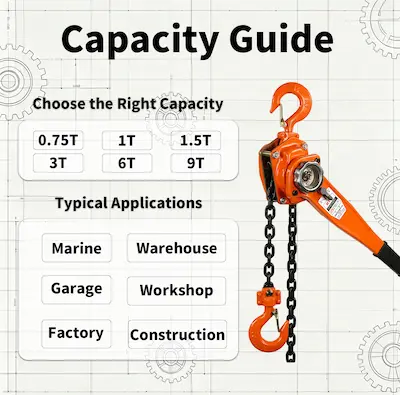
Due to their versatility, heavy-duty durability, and compact design, manual lever blocks are trusted across multiple industrial environments:
- Construction & Infrastructure: Perfect for aligning steel beams, tensioning cable lines, and pulling heavy pipes.
- Power & Utility Sectors: Widely used for line-sagging, wire tensioning, and positioning power transformers.
- Automotive & Maintenance Garages: Ideal for pulling heavy engines, machinery realignment, and workshop lifting.
- Shipyards & Steel Fab: Commonly used to tension steel hull sections together prior to heavy welding processes.
- Mining & Forestry: Trusted for extracting jammed machinery, clearing timber logs, and hoisting in tight, deep-shaft spaces.
If you require vertical-only heavy lifting inside standard facilities, you can compare these units with our high-quality manual chain hoists to determine which tool matches your specific operational layout.
5 Key Factors to Consider Before Buying a Lever Hoist
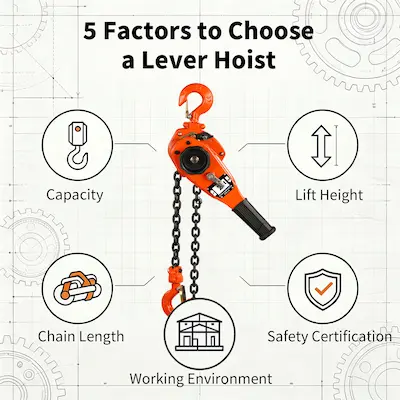
Selecting the ideal lever block is vital for both structural safety and operational efficiency. Here are the five most critical factors industrial procurement officers and rigging experts must evaluate before purchasing:
The rated capacity is the maximum weight the hoist is engineered to lift or pull safely. Overloading lifting gear is extremely dangerous. KYLIFT manufactures robust manual hoists across a variety of load ranges, from lightweight 0.25 Ton / 0.5 Ton mini models to heavy-duty 9-Ton configurations.
Buyer’s Tip: Always size your hoist with a safety margin. If your heavy rigging loads average around 1.7 Tons, purchase a 2-Ton or 3-Ton hoist rather than pushing a 1.5-Ton hoist to its limit. Choosing a highly underrated model leads to structural hazards, while selecting an overly large model adds unnecessary self-weight, making physical handling more tiring.
The lift height specifies the distance between the upper and lower hooks when the load chain is fully extended. While standard stock lifts are 1.5 meters (5 feet) or 3 meters (10 feet), professional suppliers can easily customize chain lengths to your project’s specifications.
In addition to lift height, pay close attention to headroom (the minimum distance between hooks when fully retracted). For tight spaces with restricted overhead clearances, choosing a compact headroom hoist is crucial to maximize available vertical movement. (For restricted factory environments, see our low headroom electric chain hoists for power-lifting alternatives).
The load chain handles the entirety of the tension. Never purchase a lever hoist that does not feature premium-grade, heat-treated G80 (Grade 80) alloy steel chains or higher. G80 chains deliver superior tensile strength, remarkable toughness, and excellent wear resistance.
If your equipment will operate in marine, offshore, or chemical environments, opt for galvanized or zinc-plated G80 chains to resist corrosion. Be sure to clarify your required load chain lengths during procurement to avoid the hazardous practice of welding or splicing chains manually later.
The physical location of your operations plays a huge role in determining the type of gear housing required:
- Heavy Industrial Workshops: A robust, impact-resistant steel housing protects internal gears and brake components from flying debris and dust.
- Marine & Offshore Environments: For chemical processing and outdoor construction sites, buy a lever block designed with corrosion-proof plating and an enclosed brake mechanism to keep dust, moisture, and salt spray out of the braking systems.
- Explosive Atmospheres: For coal mining or gas plants, explosion-proof, spark-resistant materials (such as bronze-coated hooks and specialized aluminum-bronze chains) are legally mandated.
Safety is non-negotiable. Top-tier industrial lever hoists must incorporate an automatic double-pawl braking system. This mechanical layout ensures that even if one pawl slips or wears down, the secondary pawl immediately locks into the ratchet gear to prevent load slippage or free-falling.
Additionally, make sure your manufacturing partner is certified to international quality standards. At KYLIFT, our manual lifting lines are engineered under strict ISO quality control protocols, which you can read about on our About Us page.
No matter how robust your manual lever block is, regular inspections prevent workplace accidents and prolong tool life. Before each shift, operators must inspect the hooks, chain integrity, and brake responsiveness. For a step-by-step procedure, check out our Hand Chain Hoist Daily Inspection Checklist, which shares identical daily safety baselines suitable for lever hoists.
Frequently Asked Questions (FAQ)
Looking for a Reliable Lever Hoist Factory Supplier?
KYLIFT is a leading lifting equipment manufacturer of manual lever hoists, electric wire rope hoists, winches, and material handling solutions. We provide direct-factory wholesale prices, strict quality standards, and OEM/ODM services for distributors worldwide.
Review our full range of technical specifications on our official Lever Hoist Product Page or request an engineered solution today!
Request a Quick Factory Quote