
Wire Rope vs Chain Hoist: Which Lifting Equipment is Right for You?
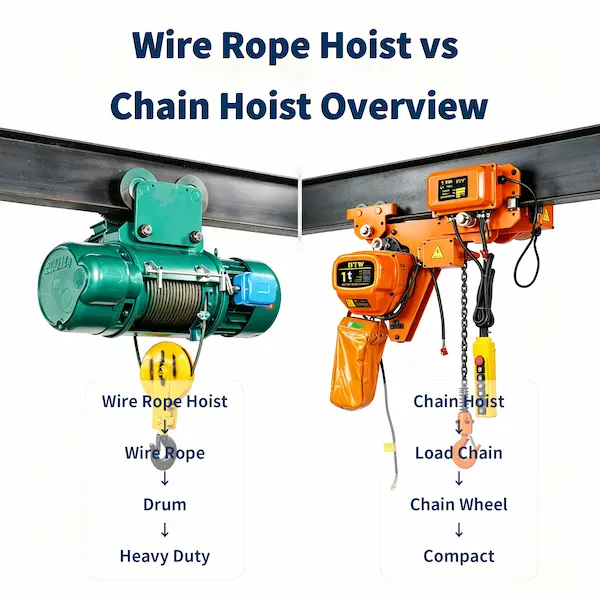
Selecting the correct industrial hoist is a critical decision for plant engineers, procurement officers, and safety managers. Choosing between a wire rope hoist and an electric chain hoist directly impacts operational efficiency, operator safety, initial capital expenditure, and long-term maintenance overhead.
While both lifting systems convert electrical energy into mechanical vertical lift, they rely on distinctly different mechanical designs, load-bearing mediums, and drum/spooling configurations. This comprehensive guide breaks down the engineering differences, lifting dynamics, and practical application scenarios to help you select the ideal hoist for your facility.
Section 1: What Are Wire Rope Hoists and Chain Hoists?
Before comparing performance metrics, it is essential to understand the structural fundamentals and lifting mediums of each equipment type.
Wire Rope Hoist
A wire rope hoist utilizes multi-strand steel wire rope wound around a grooved metallic drum. Driven by an electric motor and heavy-duty gearbox, the rope spools cleanly across the drum to raise or lower the load hook.
- Lifting Medium: High-tensile steel wire rope.
- Drive Mechanism: Cylindrical drum with rope guide grooves.
- Core Advantage: Exceptional high-speed capability, smooth operation, and extreme tonnage support.
- Best Suited For: Heavy industrial cranes, steel mills, ports, and high-duty cycle environments.
Chain Hoist
A chain hoist employs calibrated load chain that passes through a precision-machined load sheaf or pocket wheel. As the wheel rotates, the individual chain links interlock into the pockets to lift or lower the suspended load.
- Lifting Medium: Calibrated Grade 80 or Grade 100 alloy steel chain.
- Drive Mechanism: Pocketed load wheel with chain guide.
- Core Advantage: True vertical lift (no lateral drift), compact body footprint, and easy maintenance.
- Best Suited For: General manufacturing workshops, warehouse lifting systems, and assembly lines.
Section 2: Key Differences Comparison
To provide a clear side-by-side evaluation, the technical matrix below summarizes the operational and structural differences between wire rope hoists and chain hoists.
| Feature / Parameter | Wire Rope Hoist | Electric Chain Hoist |
|---|---|---|
| Lifting Speed | Faster (High-speed lifting available) | Moderate to High (Dual-speed available) |
| Lifting Capacity Range | Higher (5 Tons to 30+ Tons standard) | Medium to High (0.5 Ton to 10–20 Tons) |
| Physical Footprint & Size | Larger, heavier deadweight | Compact, lightweight design |
| True Vertical Lift | Requires double-grooved drum (or hook drifts laterally) | Standard (True vertical lift inherent in design) |
| Maintenance Complexity | More complex (Rope guide, drum, strand checks) | Easier (Chain lubrication & wear gauge inspection) |
| Portability & Flexibility | Limited (Mainly fixed overhead or gantry mount) | High (Easy to re-install or move across stations) |
| Initial Investment Cost | Higher capital cost | Lower to moderate cost (Higher ROI for small-med ops) |
| Primary Applications | Heavy machinery, foundries, shipyards | Workshops, assembly plants, warehouses, maintenance |
Section 3: Lifting Capacity Comparison
It is a common misconception that wire rope hoists are always “superior” simply because they handle higher maximum tonnages. In modern material handling, capacity selection depends on duty class, lifting height, and facility structure.
Wire Rope Hoists: Built for Heavy Tonnage & Extreme Lift Heights
When lifting requirements exceed 10 to 15 tons, or when lift heights reach 18 to 30+ meters, wire rope hoists are the industry standard. Their drum winding mechanism handles long rope lengths efficiently without cluttering the working zone. Furthermore, in high-duty cycle applications (such as continuous steel billet handling), wire rope dissipates operational heat effectively.
Chain Hoists: Precision & Efficiency for Light-to-Medium Duties
For operations under 5 tons—and up to 10 tons in standard industrial settings—fixed electric chain hoists offer optimal structural efficiency. Unlike wire rope drums, which grow larger and heavier as capacity increases, a chain hoist manages extra load capacity simply by adding chain falls (e.g., 2-fall or 4-fall reeving) while keeping the main motor housing compact.
Section 4: Speed and Efficiency
Engineering Insight: Speed vs. Precision Positioning
Wire rope hoists excel in rapid vertical travel over long distances, whereas chain hoists offer superior millimeter-level positioning accuracy—critical when mounting heavy tooling or assembling precise machinery components.
Wire Rope Hoist Performance Profile
- High Linear Speeds: Wire rope hoists can achieve rapid lifting speeds (up to 8–12 m/min or higher), reducing cycle times in deep pits or high-bay facilities.
- Smooth continuous duty: Designed for seamless integration into double-girder overhead cranes where high-speed cross-travel is required.
Chain Hoist Performance Profile
- Dual-Speed Precision: Most premium chain hoists feature 2-speed inverter or dual-winding controls (e.g., fast speed for rapid positioning and slow creep speed for delicate placement).
- Zero Lateral Drift: As chain drops straight down from the load wheel, the hook does not shift sideways during lifting, eliminating load swing and improving positioning accuracy in tight spaces like workshop maintenance stations.
Section 5: Durability and Maintenance
Long-term maintenance overhead is a primary driver of Total Cost of Ownership (TCO). Both lifting mediums require distinct daily and periodic maintenance routines.
Wire Rope Hoist Maintenance Considerations
Steel wire rope consists of hundreds of individual individual wires twisted around a core. Over time, flexing around the drum causes fatigue.
- Regular Inspections: Operators must check for broken wire strands, bird-caging, kinking, and drum groove wear.
- Rope Replacement: Replacing a wire rope requires proper re-spooling under tension to prevent overlap, requiring trained service technicians.
- Rope Guide Checks: The mechanical rope guide must be monitored continuously to ensure the rope stays within its grooves.
Chain Hoist Maintenance Considerations
Load chain maintenance is straightforward and cost-effective for internal plant teams.
- Routine Lubrication: Regular application of chain lubricant reduces friction between interlinking chain links, significantly extending service life.
- Wear Measurement: Maintenance staff can easily measure chain link pitch and diameter using a standard caliper to verify safety compliance.
- Quick Replacement: Replacing a load chain is far simpler and less time-consuming than re-spooling a wire rope drum.
Section 6: Application Comparison
Selecting the right hoist depends heavily on your specific operating environment. Here is where each technology delivers the highest ROI:
Wire Rope Hoist Applications
- Steel Mills & Foundries: Heavy ingot and ladle handling requiring high heat resistance.
- Shipyards & Docks: Heavy marine engine positioning and hull block assembly (Learn more in our shipyard lifting solutions).
- Mining & Processing: High-capacity material extraction over long vertical lift distances (mining lifting guide).
- Heavy Machinery Plants: Moving massive molds, dies, and structural steel fabrications.
Electric Chain Hoist Applications
- Automotive & Manufacturing Workshops: High-frequency assembly line lifting.
- Warehouses & Logistics Hubs: Pallet loading and localized work-cell lifting.
- Low Headroom Workspaces: Workstations with tight ceiling clearances (low headroom chain hoists).
- Construction Sites: Mobile vertical lifting for scaffolding and formwork (construction lifting solutions).
Section 7: How to Choose Between Wire Rope and Chain Hoist
Follow this step-by-step decision framework designed by KYLIFT application engineers to determine the exact equipment for your facility:
• Under 5 Tons → Chain Hoist recommended
• 5 Tons to 10 Tons → Either (Evaluate headroom & budget)
• Over 15 Tons → Wire Rope Hoist recommended
• Under 12 meters → Electric Chain Hoist
• Over 18 meters → Wire Rope Hoist (Prevents chain box overcrowding)
• Yes (Assembly/Precision alignment) → Chain Hoist
• No (General high-speed transfer) → Wire Rope Hoist
• Compact space & tight budget → Chain Hoist
• Heavy duty crane system & high budget → Wire Rope Hoist
Section 8: Why Choose KYLIFT Electric Chain Hoists?
As a leading lifting equipment manufacturer operated by Hebei Shoupai Hoisting Machinery Manufacturing Co., Ltd., KYLIFT delivers factory-direct lifting solutions built for rigorous industrial use.
When your operational analysis points toward a chain hoist, KYLIFT provides industry-leading engineering advantages:
- Calibrated G80 / G100 Alloy Steel Chains: Heat-treated load chains designed for high tensile strength, continuous wear resistance, and safety compliance.
- Dual-Safety Braking Systems: Heavy-duty electromagnetic brakes combined with mechanical load brakes ensure 100% fail-safe stopping power.
- 125% Factory Load Testing: Every single hoist undergoes rigorous 125% rated load testing and functional quality control before packing (read about our 9-step quality inspection process).
- Custom OEM & Monorail Configurations: Available in fixed type, motorized trolley electric chain hoists, and ultra-low headroom designs.