
Best Hoist for Small Workshops: The Ultimate Space-Saving Guide
Managing material handling in tight layout environments poses unique operational challenges. Unlike large-scale industrial distribution centers or heavy fabrication shipyards that utilize massive overhead cranes, limited footprint settings require highly efficient, space-saving lifting machinery. Selecting the best hoist for small workshops, automotive garages, or maintenance bays requires balancing heavy load performance against headroom clearance and power constraints.
As a leading global material handling equipment manufacturer, the KYLIFT engineering group fields daily technical requests from small-scale fabricators, vehicle repair mechanics, and small batch assembly business managers. In this guide, we break down why the compact mini electric hoist serves as the premier solution for standard duty workshop environments.
Why Space-Saving Machinery Matters in Small Workshops
In a small-scale engineering environment, space efficiency is directly correlated with workshop safety and workflow productivity. Bulky floor cranes like engine hoists take up valuable square footage when parked, creating aisle bottlenecks and increasing trip hazards. For operations involving light repetitive lifting, switching to an overhead-mounted rail or gantry setup significantly opens up floor area.
However, many standard fixed type electric chain hoists or larger commercial wire rope blocks are over-engineered for light-industrial or residential workshop use. They are physically heavy, demand industrial three-phase power connections (380V/415V), and exhibit a tall body profile that compromises hook-to-ceiling clearance, commonly referred to as headroom. For low-ceiling environments, a dedicated low headroom hoist or a highly compact wire rope variant is indispensable.
The Top Choice: PA Series Mini Electric Hoist
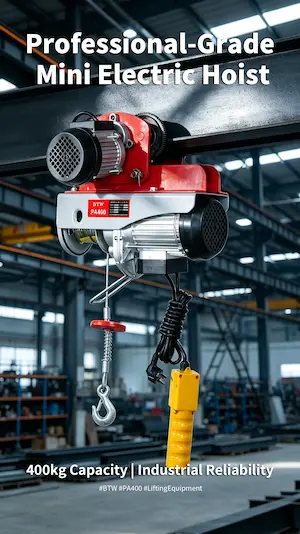
For standard garage maintenance, light manufacturing assembly lines, and commercial workshops, the PA Series Mini Electric Hoist stands out as the ultimate space-saving, high-efficiency machine. Known in the industry as a lightweight electric hoist, it offers unique electrical and mechanical structural advantages for small operations:
- Single-Phase Versatility: Unlike massive plant cranes, mini electric hoists run seamlessly on single-phase household power supplies (110V or 220V/230V). This eliminates expensive electrical grid retrofitting costs for small businesses.
- Compact & Lightweight Footprint: Engineered with a high-tensile pressed steel housing, these units feature an exceptionally low structural weight, making them safe to mount onto light duty steel frames, portable gantries, or pivoting jib arms.
- Flexible Double-Line Configuration: Built to adapt to varied tasks, the hoist hook can be rigged in a single-line setup for maximum speed, or wrapped through a companion return pulley block to double the maximum lifting threshold.
| Model Type | Rigging Method | Rated Capacity (kg) | Lifting Speed (m/min) | Standard Lift Height (m) |
|---|---|---|---|---|
| PA200 | Single Line | 100 | 10 | 12 |
| Double Line | 200 | 5 | 6 | |
| PA500 | Single Line | 250 | 10 | 12 |
| Double Line | 500 | 5 | 6 | |
| PA1000 | Single Line | 500 | 8 | 12 |
| Double Line | 1000 | 4 | 6 |
Fixed vs. Mobile Configurations for Workshop Layouts
When implementing a workshop electric hoist, users must decide between static vertical lifting or horizontal material transport along a structural cross-beam.
Stationary Fixed Type Mounting
The standard fixed mini hoist is clamped onto a fixed overhead pipe or square support frame using the dual-bracket system provided by the manufacturer. This configuration is optimal for dedicated workstations, such as positioning raw metal plates onto a CNC plasma cutting table, or lifting engines straight up onto a workbench.
Horizontal Travel via Beam Trolley
To extend the capability across an entire bay, integrating the unit with a dedicated GCT plain or geared trolley, or a motorized electric trolley companion is highly recommended. The combined trolley-hoist assembly rides safely along the bottom flange of an I-beam or H-beam steel member, allowing an operator to effortlessly roll heavy assemblies from the unloading dock directly to the assembly staging line.
E-E-A-T Safety & Maintenance Insights for Small Operators
Based on decade-long field testing data compiled by the KYLIFT quality control lab, small workshop operators often make the mistake of pushing machinery past duty cycles due to the hoist’s small appearance. To maintain peak operation and extend the life of your equipment, adhere to the following safety protocols:
- Thermal Protection Cycles: Mini wire rope units are typically rated for intermittent duty cycles (S3-20% 10 min). Allow the copper motor adequate cooling time between continuous, heavy lifts to prevent thermal overload switches from tripping.
- Wire Rope Fleet Angles: Avoid dragging loads sideways. Side pulling creates uneven spooling on the rope drum, causing dangerous binding, wire crushing, and premature cable degradation.
- Rigging & Brake Checkups: Implement a mandatory safety assessment routine before operations begin. Inspect hooks for neck twisting or latch failures, and check the friction braking disc for signs of slippage under load. For heavier manual gear variants, consulting a professional hand chain hoist daily inspection checklist can help align standard workplace safety behaviors.
Optimize Your Workshop Lifting Operations Today
KYLIFT manufactures high-performance PA Series mini electric hoists, industrial grade chain blocks, and rugged beam trolleys tailored for factory wholesale distribution and small-to-medium enterprise integration. We provide custom voltage modifications, OEM product branding, and global delivery solutions direct from our manufacturing plant.
Contact our technical engineering sales staff today for wholesale pricing matrices or a detailed product catalog.
Request a Direct Factory Quote