
Top Selling Hoists: Popular Hoist Types for Different Applications
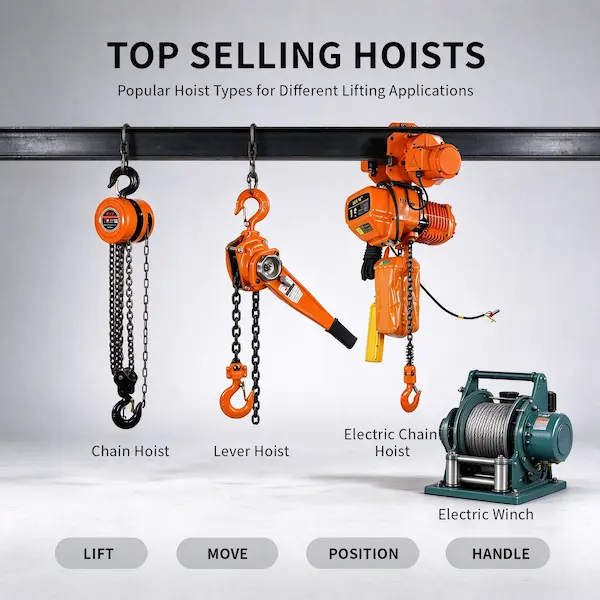
When selecting material handling equipment for industrial workshops, warehouses, or construction sites, understanding the market’s top selling hoists is essential. Not all lifting equipment serves the same purpose; matching the right hoist type to your precise application dictates both operational efficiency and job site safety.
1. What Makes a Hoist Popular?
Why do certain lifting devices consistently rank among best selling hoists across global manufacturing and logistics sectors? Popularity is driven by a combination of reliability, cost-efficiency, safety features, and adaptability. When engineering teams or facility managers search for popular hoists, they evaluate several critical factors:
- Application: Whether the task involves vertical lifting, horizontal pulling, or precise component positioning.
- Capacity: Matching equipment to actual working loads (read our detailed Hoist Capacity Buying Guide for precise calculations).
- Lifting Frequency & Duty Cycle: Occasional maintenance versus high-volume, repetitive warehouse shifts.
- Power Availability: Manual operation vs. electric power (single-phase or three-phase).
- Installation & Portability: Fixed overhead mounting, temporary rigging, or easy relocation between sites.
- Working Environment: Dust, humidity, outdoor exposure, or corrosive atmospheres.
2. Popular Types of Hoists
The industrial market features several core types of hoists designed to handle diverse mechanical and operational challenges. A quick overview establishes our primary categories:
- Manual Chain Hoist: Ideal for heavy-duty manual vertical lifting without reliance on electricity.
- Lever Hoist: Compact and versatile equipment for pulling, lifting, and precise component positioning.
- Electric Chain Hoist: Powered machinery engineered for high-frequency, repetitive vertical lifting.
- Wire Rope Hoist / Winch Systems: Heavy industrial solutions for extended heights or specialized pulling applications.
3. Chain Hoist
The manual chain hoist remains a staple in workshops and construction sites worldwide due to its robust design and straightforward mechanical advantage. Key characteristics include:
- Manual pull-chain operation requiring zero electricity.
- High portability and simple mechanical structure.
- Exceptional reliability for occasional lifting, maintenance bays, and remote construction zones.
For operations requiring portable yet durable manual lifting, explore our HSZ Manual Chain Hoist or the heavy-duty HSC Manual Chain Hoist designed for demanding environments[cite: 1, 4, 6].
4. Lever Hoist
Unlike traditional vertical chain blocks, lever hoists utilize a ratcheting handle mechanism that enables multidirectional force application. Key highlights include:
- Compact, lightweight, and highly portable.
- Exceptional performance not only for lifting, but also for pulling, binding, and tensioning.
- Indispensable in tight spaces, machinery installation, and structural alignment.
5. Electric Chain Hoist
As modern warehouses and production facilities scale up, manual effort is increasingly replaced by automated solutions. The electric chain hoist is a core product range for high-efficiency environments:
- Powered lifting that drastically reduces operator fatigue during repetitive tasks.
- Ideal for assembly lines, warehousing bays, and continuous material handling.
- Can be integrated with trolley systems for horizontal movement along overhead beams.
To maximize throughput, facilities often deploy our Fixed Electric Chain Hoist for stationary vertical lifts, or combine it with a Motorized Trolley Hoist for seamless horizontal repositioning[cite: 1, 4]. For low-ceiling facilities, a Low Headroom Hoist guarantees maximum lifting height[cite: 1, 4].
6. Electric Winch vs Hoist
A common point of confusion among buyers is distinguishing between an industrial hoist and a winch. As covered in our guide on Electric Winch Advantages, their mechanical functions differ fundamentally:
- Hoist: Engineered specifically to lift and lower loads vertically under strict safety brake controls.
- Winch: Designed primarily to pull and position loads horizontally or along inclined planes.
7. Which Hoist for Which Application?
Choosing the right lifting hoist requires evaluating your specific industry application:
- Workshops & Machinery Maintenance: Chain Hoist, Lever Hoist, or Fixed Electric Chain Hoist for servicing heavy components.
- Warehousing & Distribution Centers: Electric Chain Hoist and Motorized Trolley systems for rapid pallet handling and inventory flow[cite: 4].
- Construction Sites: Manual Chain Hoist and Lever Hoist for rugged on-site rigging and steel erection[cite: 7].
- Shipyards & Marine: Corrosion-resistant manual and electric configurations designed for harsh port conditions[cite: 8].
8. How to Choose the Right Hoist Capacity
Selecting equipment based solely on estimated cargo weight is a dangerous pitfall that can lead to mechanical failure. As detailed in our technical resource on Hoist Overloading Risks and Prevention, you must calculate your complete lifting system:
Actual Cargo Load + Rigging Accessories (Slings, Shackles, Beams) → Required Rated Capacity → Verified Supporting Structure
Never exceed the manufacturer’s rated working load limit (WLL), and always factor in duty cycles and dynamic shock loading.
9. Manual Hoist vs Electric Hoist
| Feature | Chain Hoist (Manual) | Lever Hoist (Manual) | Electric Chain Hoist |
|---|---|---|---|
| Power Source | Manual Force | Manual Force | Electric Power (AC) |
| Primary Use | Vertical Lifting | Lifting, Pulling & Positioning | Repetitive Vertical/Horizontal Lifting |
| Portability | High | High | Depends on Installation / Trolley |
| Operator Effort | Moderate (Hand Chain) | Moderate (Lever Handle) | Minimal (Push-Button Control) |
| Typical Environment | Maintenance / Workshops | Construction / Tight Rigging | Warehouses / Production Lines |
10. Hoist Buying Checklist
Quick Procurement Checklist
- ✓ Load Capacity: Covers maximum cargo plus all rigging gear.
- ✓ Lifting Height: Adequate chain/rope length for your vertical clearance.
- ✓ Working Frequency: Continuous production vs occasional maintenance.
- ✓ Power Supply: Voltage and phase availability on-site (if electric).
- ✓ Installation Structure: Overhead gantry, monorail beam, or crane bridge rating.
- ✓ Portability: Fixed workstation vs multi-site mobility.
11. Hoist Safety Basics
Safety is non-negotiable in material handling. Implement these core protocols before every lift:
- Verify the rated capacity on the equipment nameplate.
- Thoroughly inspect load hooks, safety latches, and chains/wire ropes for wear or deformation.
- Ensure the supporting overhead structure can safely bear the total applied load.
- Use proper rigging accessories and keep unauthorized personnel clear of the drop zone.
12. KYLIFT Hoist Range
As a leading manufacturer of industrial lifting solutions, KYLIFT provides certified, durable equipment engineered for global industrial standards. Explore our core product lineups:
- Manual Chain Hoists: Reliable manual lifting featuring models like HSZ and HSC series[cite: 1, 4, 6].
- Lever Hoists: Heavy-duty ratcheting pullers for precise positioning and alignment.
- Electric Chain Hoists: Fixed and motorized trolley variants designed for high-efficiency warehouse automation[cite: 1, 4].
- Electric Winches: Robust KCD series built for heavy pulling and marine applications[cite: 9].
13. Ready to Upgrade Your Lifting Operations?
Need Help Choosing a Hoist?
Tell us about your application requirements, and our engineering team will help you identify the ideal equipment:
- Load Capacity & Lifting Height
- Application & Working Environment
- Working Frequency & Power Supply
- Installation Type & Required Quantity
Tell Us About Your Application — We’ll Help You Identify a Suitable Hoist.