
Electric Winch Advantages: Why Choose an Electric Winch?
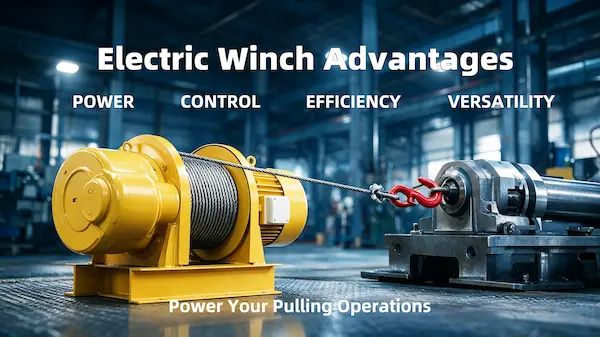
Note: Electric winches are not always mandatory, but they provide a highly practical choice when repeated pulling or material-handling tasks require consistent powered operation.
In heavy manufacturing, construction, and logistics, horizontal material handling often presents distinct challenges compared to overhead lifting. When heavy loads, machinery, or components need to be dragged, aligned, or moved across surfaces, facility managers face a crucial equipment decision. Understanding key electric winch advantages helps buyers evaluate whether powered pulling is right for their operational needs.
What Is an Electric Winch?
At its core, an electric winch uses an electric motor and drive system to wind a wire rope or cable onto a drum to generate pulling force. Unlike standard overhead hoists, winches are structured to withstand linear tension along horizontally or inclined paths.
Main components of a standard industrial electric winch include:
- Electric Motor: Provides continuous mechanical driving power.
- Gearbox: Multiplies torque and converts high-speed rotation into controlled pulling strength.
- Drum: Spools and stores the wire rope securely during operations.
- Wire Rope / Cable: Transmits pulling force to the target load.
- Control System: Enables operator control via pendant controllers or wireless remotes.
- Hook: Connects directly or via rigging hardware to the load.
By relying on motor power rather than physical force, an electric winch significantly reduces the strain needed to relocate heavy materials across job sites.
1. Reduced Manual Effort
The most immediate advantage of an electric winch is physical effort reduction. Manual hauling methods require physical exertion from one or more workers, leading to physical fatigue and lower operational consistency over time.
- Manual Pulling Model: Operator → Physical Effort → Load
- Electric Winch Model: Motor → Gear System → Controlled Pulling
By transferring load resistance directly to an electric gear drive, operators avoid physical strain during routine material repositioning.
2. Faster and More Efficient Operations
For repetitive pulling tasks—such as positioning heavy equipment, recovering vehicles, moving steel components, or pulling cable through conduits—powered machinery maintains a consistent line speed. Powered operation can improve efficiency in repetitive pulling tasks compared with manual methods, depending on the specific application environment.
3. Easier Operation
Modern industrial winches feature intuitive control systems that simplify operator training. Operators manage load movements using:
- Pendant Controls: Ergonomic hand-held switches wired to the unit.
- Remote Control (Model Dependent): Wireless controllers that allow operators to stand at a safe vantage point during operations.
Control layouts typically feature clearly labeled pushbuttons (e.g., FORWARD / REVERSE or PULL / RELEASE depending on equipment specifications) to minimize operational friction.
4. Better Control During Pulling
Beyond speed, precise load positioning is critical when moving high-value machinery or heavy components in tight spaces. Electric winches offer smooth starter action, controlled line speed, and immediate braking, facilitating accurate alignment during setup, tensioning, and horizontal transfer.
5. Suitable for Repetitive Work
If a facility pulls or moves a load once a week, a manual block or hand winch may be sufficient. However, when tasks occur dozens or hundreds of times a shift, electric winches become indispensable across industrial facilities, including:
- Workshop & Maintenance Facilities for machinery positioning
- Shipyards & Marine Operations for hauling and dockside material handling
- Construction Sites for structural material positioning
- Mining & Heavy Industry Sites for heavy drag hauling
6. Flexible Applications
Electric winches support a wide variety of material handling scenarios across multiple industries:
- Industrial Material Handling: Dragging heavy steel beams, machinery bases, and prefabricated molds across shop floors.
- Vehicle & Trailer Handling: Assisting in trailer loading, equipment positioning, and recovery tasks.
- Marine Applications: Dockside tensioning, slipway pulling, and deck material handling.
- Construction & Rigging: Moving heavy equipment, setting up staging areas, and tensioning structural components.
7. Compact Design for Practical Installation
Depending on the model, electric winches can offer a compact solution for applications where installation space is limited. Modern winch frames integrate the motor, gearbox, and drum into a unified footprint, allowing versatile mounting on floor frames, structural beams, or specialized mobile rigs.
8. Electric Winch vs Manual Pulling
To better understand when to upgrade from manual hand winches to electric power, consider this comparison:
| Factor | Manual Pulling | Electric Winch |
|---|---|---|
| Power Source | Operator Physical Muscle | Electric Motor (AC/DC) |
| Physical Strain | Higher (Fatigue builds up) | Lower (Button operated) |
| Repetitive Suitability | Less convenient for high duty cycles | Highly suitable for continuous tasks |
| Control Type | Direct Manual Lever / Crank | Pendant / Remote Control Switch |
| Productivity Output | Varies by operator endurance | Consistent motor performance |
9. Electric Winch vs Electric Hoist
Buyers often confuse winches with electric chain hoists. Understanding the distinction ensures proper equipment selection and jobsite safety:
- Electric Hoist: Engineered specifically for Vertical Lifting (raising and lowering suspended loads safely using dynamic mechanical load brakes). Explore our Fixed Electric Chain Hoist line for standard overhead lifting requirements.
- Electric Winch: Engineered primarily for Horizontal Pulling, Hauling & Tensioning (moving loads along flat or inclined planes).
10. What to Consider Before Buying an Electric Winch
When selecting an electric winch for your job site, verify the following specifications:
- Rated Line Pull: Ensure the unit’s single-line pulling capacity matches your maximum expected load resistance (note: line pull differs from vertical lifting capacity).
- Rope Length & Diameter: Determine the travel distance needed and ensure appropriate drum rope capacity.
- Power Supply Requirements: Match the motor voltage, phase, and frequency to your available site power (e.g., 220V/380V/440V, 3-Phase).
- Duty Cycle Rating: Choose a duty class that corresponds to your expected operating hours per shift.
- Mounting Arrangement: Confirm structural floor mounting or baseplate bolt patterns.
- Application & Environment: Account for ambient temperature, outdoor exposure, humidity, or marine conditions.
Safety Considerations for Winch Operations
Regardless of winch advantages, strict safety practices must always be followed:
- Never exceed the rated line pull limit.
- Inspect the wire rope regularly for kinks, frayed strands, or deformation.
- Check hook safety latches and mounting bolts before every shift.
- Ensure all personnel stand clear of the wire rope tension zone during pulling.
- Avoid side-loading the drum unless specifically approved by the manufacturer.
- Always follow the manufacturer’s official operation manual and rigging standards.
KYLIFT Electric Winch Solutions
At KYLIFT (operated by Hebei Shoupai Hoisting Machinery Manufacturing Co., Ltd.), we supply industrial-grade electric winches, including the popular KCD Electric Winch Series, designed for reliable pulling and material handling across engineering and industrial projects.
Looking for the Right Electric Winch Solution?
Tell us your required line pull, rope length, application, power supply, and working environment. Our technical engineering team can recommend a tailored configuration for your workflow.
Request a Quote