
220V Electric Winch: Applications and Selection Guide
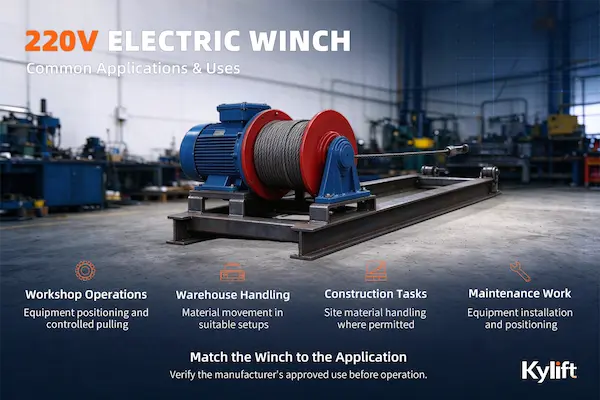
Many workshops, warehouses, and job sites need reliable pulling or lifting power, yet only have standard 220V electricity available instead of heavy industrial 380V three-phase power. Whether you are installing machinery, moving materials in a warehouse, or handling equipment on a construction site, a 220V electric winch often bridges the gap between manual labor and large-scale industrial hoists.
However, buyers frequently hesitate when specifying a 220V unit: Can 220V power handle the required load? Will the motor overheat under frequent operation? Is a winch even the right tool for vertical lifting? This guide explains how 220V electric winches work, their real-world applications, and the exact technical parameters you need to evaluate before requesting a quote.
1. What Is a 220V Electric Winch?
A 220V electric winch is a mechanical device powered by a 220V–240V electric motor that winds wire rope onto a cylindrical drum to pull or lift heavy loads. When the operator engages the control pendant or remote, the motor drives a reduction gearbox, which multiplies torque and rotates the drum at a controlled speed.
A standard industrial 220V electric winch consists of five core components:
- Electric Motor: Converts 220V electrical energy into rotational mechanical power.
- Reduction Gearbox: Uses planetary or helical gears to reduce motor RPM and increase pulling torque.
- Wire Rope Drum: Stores the steel wire rope and winds it in layers during operation.
- Wire Rope & Hook: Transfers the pulling or lifting force to the load.
- Braking System: Typically an electromagnetic or mechanical fail-safe brake that locks the drum immediately when power is cut.
Depending on your facility’s electrical grid, 220V winches are built for either 220V–240V single-phase power (common in workshops, garages, and light commercial buildings) or 220V three-phase power (used in specific regions such as parts of North America, Japan, and Latin America). Three-phase 220V motors deliver smoother torque and handle heavier duty cycles than single-phase units.
Electric Winch vs. Electric Hoist
Buyers often confuse winches with electric hoists. While both use motors and wire rope or chain, they are engineered for different load paths and safety standards.
| Feature | Electric Winch | Electric Hoist |
|---|---|---|
| Main mechanism | Drum and wire rope | Chain or wire rope lifting mechanism |
| Common applications | Pulling or lifting, depending on design | Vertical lifting |
| Installation | Base or frame mounted | Fixed or trolley mounted |
| Selection focus | Line pull, rope capacity, duty cycle | Lifting capacity, headroom, lifting height |
2. Common Applications of 220V Electric Winches
Because 220V power is widely accessible, these winches are deployed across light-to-medium industrial environments where 380V–480V three-phase lines are unavailable or impractical to install.
2.1 Workshops and Equipment Maintenance
In machine shops, repair bays, and fabrication facilities, 220V electric winches simplify heavy maintenance tasks. Technicians use them to pull engines, position heavy dies, align structural frames, and drag machinery onto maintenance skids. Because most workshops already have 220V single-phase outlets, a base-mounted winch can be installed on a floor plate or gantry frame without expensive electrical upgrades. Compact models with pendant controls allow a single operator to position components safely and accurately.
2.2 Warehouses and Material Handling
Warehouses and logistics centers rely on 220V winches for moving palletized goods, pulling heavy crates across loading docks, and operating small freight lifts or dumbwaiters (when rated for vertical lifting). In facilities without overhead bridge cranes, a fixed 220V winch paired with a jib arm or pulley block provides an economical material handling solution. Matching the winch’s duty cycle to daily warehouse throughput ensures reliable operation without premature motor wear.
2.3 Construction and Installation Projects
On residential and commercial construction sites, portable generators or temporary site distribution boards frequently supply 220V power. Contractors use 220V winches to hoist scaffolding tubes, roofing materials, HVAC units, and piping to upper floors. For any overhead or vertical construction lifting, you must select a winch explicitly certified for lifting duty, equipped with a fail-safe electromagnetic brake and upper/lower limit switches to protect workers below.
2.4 Agricultural and General Industrial Applications
Farms, grain facilities, and small processing plants use 220V electric winches to open heavy barn doors, tension conveyor belts, pull stuck agricultural implements, and service irrigation pumps. In general industry, they also drive small transfer carts and tensioning systems. Because agricultural and outdoor sites often expose equipment to dust and moisture, choosing a winch with an appropriate IP protection rating and corrosion-resistant finish is essential for long-term reliability.
3. Key Factors to Consider When Choosing a 220V Electric Winch
Selecting the right winch requires looking beyond the headline tonnage on a product label. Evaluate these six technical parameters to match the machine to your actual working conditions.
3.1 Load Capacity and Rated Line Pull
Start by calculating the exact weight of your heaviest load, including any rigging hardware, slings, or spreader beams. Next, distinguish between rated line pull (horizontal pulling force) and rated lifting capacity (vertical suspension). A winch rated for 1,000 kg of rolling horizontal pull cannot safely lift 1,000 kg vertically.
Furthermore, pay close attention to drum layer derating. A winch’s maximum rated pull is almost always measured on the first layer of wire rope closest to the drum core. As rope winds onto outer layers, the effective drum diameter increases, which reduces pulling torque. By the fourth or fifth layer, available line pull can drop by 25% to 40%. You must also account for friction, incline angles, and whether you are using snatch blocks (pulley multiplication) to increase mechanical advantage.
Key rule: Never assume a nominal “1-ton” winch can safely lift 1 ton in every configuration or rope layer.
3.2 Lifting Height and Wire Rope Length
Measure the total vertical lifting height or horizontal pulling distance required, then add a safety margin. Check the wire rope diameter and total length against the drum’s effective rope capacity. Overfilling a drum causes rope crushing and tangling.
Equally important, never unwind the wire rope completely. Most industrial standards require keeping at least 3 to 5 dead wraps of rope on the drum at full extension so the anchor clamp does not bear the full load. If your application requires long travel distances, consider a winch with a grooved drum or a level-wind (spooling) device to keep the rope neat.
3.3 Power Supply: 220V Single Phase vs. Three Phase
Confirm your exact site power before ordering. A 220–240V single-phase supply is standard in many workshops, but single-phase motors draw high starting (inrush) current and are generally limited to lighter capacities and intermittent duty. A 220V three-phase supply delivers higher starting torque, cooler operation, and better suitability for frequent industrial use.
Always verify the local frequency—50Hz vs. 60Hz. Running a 50Hz motor on 60Hz power (or vice versa) changes motor speed, alters cooling efficiency, and can trip thermal overload relays. Ensure your site’s circuit breakers and extension cables can handle the motor’s peak starting current without voltage drop, and confirm that the voltage and frequency match the winch nameplate.
3.4 Lifting or Pulling Speed
Winch line speed directly impacts workflow efficiency and load control. Standard 220V winches typically operate between 5 m/min and 20 m/min. Higher speeds improve cycle times for long-distance pulling, while slower speeds offer better control when aligning heavy machinery.
Note the physics trade-off: for a given 220V motor wattage, higher speed means lower pulling force, and higher capacity requires slower gearing. If your operation demands precise positioning—such as lowering a motor onto mounting bolts—consider a dual-speed configuration or a Variable Frequency Drive (VFD) setup rather than a basic single-speed unit.
3.5 Duty Cycle and Working Frequency
How often will the winch run? Occasional maintenance (a few lifts per week) requires far less thermal capacity than a production line running 15 cycles per hour. Check the motor’s duty cycle rating (often expressed as S3 25% or S4, or in minutes of continuous runtime per 10-minute period).
Frequent starts and stops generate rapid heat buildup in 220V motors. Quality industrial winches include thermal overload protection that shuts the motor down before windings burn out. Never treat a light-duty, intermittent 220V winch as a continuous-duty industrial hoist; doing so leads to premature brake wear and motor failure.
3.6 Safety Features and Working Environment
Never compromise on safety hardware. Verify that the winch includes an automatic fail-safe brake capable of holding 100% of the rated load if power fails. For vertical lifting, insist on upper and lower limit switches, overload protection, and an emergency stop (E-stop) button on the pendant or control box.
Match the winch’s IP (Ingress Protection) rating to its environment—IP54 or IP55 is typical for dusty workshops or light outdoor use, while wet or marine environments require higher sealing and corrosion-resistant coatings. Finally, inspect your mounting structure: the base frame, anchor bolts, and supporting beam must be engineered to withstand the winch’s maximum rated pull with an adequate safety factor.
4. How to Choose the Right 220V Electric Winch
Follow this six-step procurement workflow to translate your site conditions into an accurate winch specification:
- Define the application: Lifting or Pulling. Determine whether the load moves horizontally, up an incline, or vertically overhead. Never specify a pulling-only winch for vertical lifting.
- Confirm load capacity and travel distance. Calculate the maximum load weight (including rigging) and required rope length, factoring in drum layer derating and 3–5 dead wraps.
- Check available power supply. Verify voltage (220V–240V), phase (single-phase vs. three-phase), frequency (50Hz vs. 60Hz), and breaker capacity at the installation point.
- Determine speed and duty cycle. Estimate how many cycles per hour the winch will run and whether you need single-speed or variable-speed control for precise positioning.
- Review installation and safety requirements. Confirm base mounting dimensions, IP rating for indoor/outdoor conditions, limit switches, and emergency stop controls.
- Request a technical quotation. Share your complete operating parameters with a qualified manufacturer like Kylift to verify safety margins and get a tailored configuration.
5. Common Mistakes to Avoid When Buying a 220V Electric Winch
- Choosing a winch based only on rated capacity: Buyers often look at the maximum first-layer rating and ignore outer-layer derating or incline friction. Always size the winch for the load at the working rope layer.
- Ignoring single-phase and three-phase power differences: Ordering a 220V three-phase winch for a single-phase workshop—or vice versa—renders the equipment unusable without costly phase converters.
- Overlooking duty cycle and operating frequency: Using an intermittent-duty winch for continuous production causes motor overheating, tripped breakers, and rapid gearbox wear.
- Using a pulling winch for unsupported vertical lifting: Pulling winches lack the braking redundancy and safety factors required for overhead lifting. Doing so creates a severe drop hazard.
- Failing to check installation and safety requirements: Overlooking mounting bolt patterns, anchor strength, or IP ratings for outdoor moisture can delay commissioning and void equipment warranties.
6. 220V Electric Winch RFQ Checklist
To get an accurate recommendation and quotation without back-and-forth delays, copy and fill out the specification table below before contacting your supplier.
| Specification | Customer Requirement |
|---|---|
| Application | Lifting / Pulling |
| Required capacity | ___ kg / ton |
| Lifting height / Pulling distance | ___ m |
| Power supply | 220–240V / ___ Phase / ___ Hz |
| Required speed | ___ m/min |
| Working frequency | ___ cycles/hour |
| Wire rope requirements | Diameter ___ mm / Length ___ m |
| Installation method | Base mounted / Frame mounted / ___ |
| Working environment | Indoor / Outdoor / Dusty / Wet |
| Quantity | ___ units |
Need a 220V Electric Winch for Your Project?
Share your technical requirements with Kylift, and our engineering team will help you identify a safe, cost-effective configuration matched to your power supply and duty cycle.
Request a Quote Chat on WhatsApp7. Frequently Asked Questions About 220V Electric Winches
Can a 220V electric winch lift heavy loads?
Yes, provided the winch is specifically rated for vertical lifting and properly sized for the load. While 220V single-phase winches typically handle light-to-medium loads (often 250 kg to 2,000 kg), 220V three-phase industrial winches can handle heavier capacities. Always account for drum layer derating and use a pulley block if additional mechanical advantage is needed.
What is the difference between a 220V and 380V electric winch?
A 220V winch (usually single-phase) is designed for workshops, garages, and job sites without industrial three-phase power, making it easier to plug in and deploy. A 380V three-phase winch draws lower current for the same power output, delivers higher starting torque, and is built for heavy-duty, high-frequency industrial operations.
Can a 220V electric winch run continuously?
Most standard 220V electric winches are rated for intermittent duty (such as S3 25% or S4), meaning they require cooling periods between cycles. Running a light-duty 220V winch continuously will overheat the motor and trip thermal protection. If your process requires continuous operation, specify a heavy-duty motor with an appropriate duty rating.
Can I use a 220V electric winch for vertical lifting?
Only if the manufacturer explicitly certifies that model for vertical lifting. Many 220V winches are engineered solely for horizontal or inclined pulling and lack the fail-safe braking systems and safety factors needed to hold suspended loads. For dedicated overhead lifting, a certified lifting winch or electric wire rope hoist is required.
What information should I provide when requesting a quotation?
Provide your exact application (lifting or pulling), maximum load weight, required travel distance, power supply details (220V single-phase or three-phase, 50Hz or 60Hz), desired line speed, working frequency, and indoor/outdoor environment. Sharing these details upfront using our RFQ checklist allows Kylift to recommend the exact model and wire rope configuration.
Conclusion: Choose the Right Winch for Your Application
Selecting the right 220V electric winch comes down to three core factors: your actual application (pulling vs. lifting), your site power supply (single-phase vs. three-phase and frequency), and your working requirements (load, rope length, speed, and duty cycle). Evaluating all of these parameters together—rather than buying on headline tonnage alone—prevents motor burnout, protects your operators, and ensures reliable long-term performance.
Ready to specify your equipment? Explore our full range of Kylift electric winches or submit your RFQ today for a tailored technical quotation.