
Difference Between 220V and 380V: Which Voltage Is Right for Your Hoist?
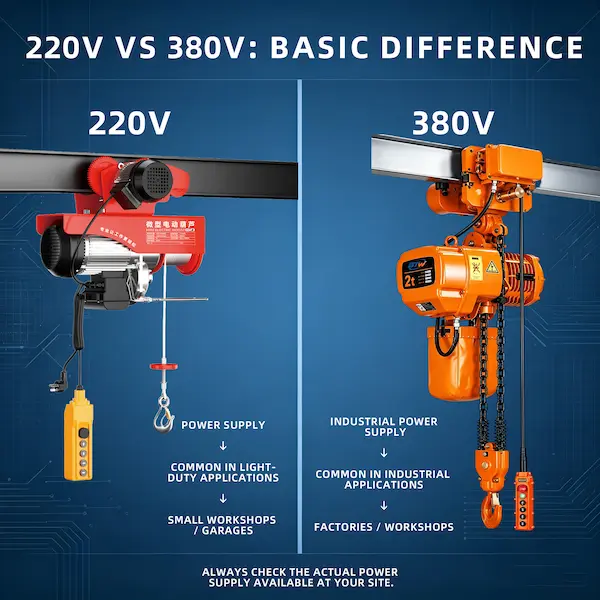
When selecting powered material handling equipment, determining the proper electrical power supply is one of the most vital technical decisions you will make. Buyers often ask us: “What is the difference between 220V and 380V?” and “Will a 220V electric hoist carry the same load as a 380V hoist?”
Selecting the correct voltage rating directly influences your equipment’s motor efficiency, duty cycle capability, installation cost, and overall operational safety. Match your power infrastructure improperly, and you risk thermal overload, reduced lifting torque, or complete operational failure. In this technical guide, our engineering team breaks down the core differences between 220V vs 380V systems to help you choose the precise configuration for your facility.
1. What Does 220V and 380V Mean?
At its core, voltage (measured in Volts, V) represents the electric potential difference driving electrical current through a motor circuit. Understanding where these two voltage standards operate is essential for identifying facility compatibility.
220V Power Supply
220V (and its nominal regional variants such as 230V or 240V) is widely available in standard commercial grids and light commercial facilities. Typical application environments include:
- Small workshops and auto repair garages
- Commercial maintenance rooms
- Light-duty fabrication units
- Residential or portable job sites
380V Power Supply
380V (along with nominal variants like 400V or 415V) is the standard commercial-industrial voltage across major regions including Europe, Asia, Africa, and parts of South America. Environments utilizing 380V include:
- Heavy manufacturing plants and assembly lines
- Industrial warehouses and logistics hubs
- Steel construction sites and foundries
- Continuous, heavy-duty processing facilities
2. 220V and 380V — What’s the Main Difference?
The primary technical distinction lies in electrical architecture, phase distribution, and power delivery capability. Below is a quick baseline comparison between standard configurations:
| Feature | 220V Electrical System | 380V Electrical System |
|---|---|---|
| Typical Use | Light to medium-duty lifting applications | Continuous, heavy-duty industrial lifting |
| Common Phase Configuration* | Predominantly Single-Phase (or 3-Phase in specific regional grids) | Predominantly Three-Phase |
| Power Availability | Common in small facilities, garages, and commercial grids | Standard in industrial manufacturing parks |
| Installation Requirements | Simpler; often direct connection or standard breakers | Requires industrial distribution panels & heavy cabling |
| Typical Equipment | Mini electric hoists, light chain blocks | Heavy-duty electric chain hoists & wire rope hoists |
3. 220V Electric Hoist Applications
A single phase electric chain hoist (220V) or 220V mini hoist offers high flexibility where industrial three-phase infrastructure is unavailable. Common scenarios include:
- Commercial Garages & Auto Shops: Engine pulling, transmission swaps, and vehicle component assembly.
- Small Workshops: Lifting metal stock, raw materials, and finished tooling on workbenches.
- Facility Maintenance Work: Elevating pumps, HVAC compressors, or spare parts in utility rooms.
- Light Manufacturing: Intermittent lifting in small assembly cells that do not require high duty-cycles.
4. 380V Electric Hoist Applications
A three phase electric chain hoist operating on 380V is designed for demanding industrial operations. Key applications include:
- Automotive & Heavy Manufacturing: High-frequency assembly line hoisting operating multi-shift operations.
- Industrial Steel Fabrication: Positioning heavy structural beams, plates, and weldments.
- Warehouse Logistics: High-speed vertical handling of heavy pallets and bulk cargo.
- Steel Structure Installation: Outdoor overhead lifting during structural erection where multi-ton capacity is mandated (see our construction site lifting guide).
5. 220V vs 380V for Electric Hoists: Impact on Performance
When selecting between a 220V and a 380V power supply for electric hoists, understanding the direct impact on equipment performance is key:
1. Motor Configuration & Efficiency
Three-phase 380V motors generate a smooth rotating magnetic field naturally. This eliminates the need for start/run capacitors required by single-phase 220V motors. Three-phase motors yield higher electrical efficiency, smoother torque curves, and less heat generation under heavy loading.
2. Available Site Power
Before purchasing, audit your facility’s electrical distribution box. Installing a 380V hoist in a facility with only 220V single-phase power will require adding a step-up transformer and phase converter or upgrading line service, significantly increasing installation expense.
3. Lifting Capacity & Motor Power
While 220V hoists can easily handle capacities up to 1 ton or 2 tons, higher capacity hoists (e.g., 1 ton electric chain hoists up to 20-ton industrial units) almost universally run on three-phase supplies (such as 380V). Note: Higher-capacity industrial hoists often use three-phase power, but the required voltage depends on the specific motor and equipment design.
4. Operating Frequency & Duty Cycle
Continuous-duty applications generate heat. Three-phase 380V hoists draw lower current (amperes) per kilowatt than 220V single-phase hoists, reducing heat buildup in windings and allowing higher FEM/ISO duty ratings for non-stop industrial cycles.
6. How to Choose Between 220V and 380V (Decision Guide)
Use the structural decision tree below to evaluate your facility power and operational demands before placing an order:
7. Why Phase and Frequency Matter (50Hz vs 60Hz)
A common pitfall in global lifting equipment procurement is specifying voltage while neglecting phase and frequency. Electrical parameters must match perfectly:
- Frequency (Hz): Running a 50Hz hoist motor on a 60Hz power supply will cause the motor to run ~20% faster, potentially reducing torque and overheating windings. Conversely, running a 60Hz motor on 50Hz causes slower speeds and thermal overload.
- Voltage Variations: Global power grids vary. Common configurations include 220V/50Hz, 220V/60Hz, 380V/50Hz, 380V/60Hz, as well as 230V, 400V, or 415V.
When ordering from Kylift, providing complete nameplate requirements ensures motor windings, brake coils, and contactors are calibrated precisely for your power grid.
8. Common Mistakes When Choosing Hoist Voltage
To prevent operational downtime and safety hazards, avoid these common mistakes (for structural safety and mistake prevention, consult our common lifting mistakes safety guide):
- Focusing on Voltage Only, Ignoring Phase: Assuming 220V is always single-phase, or assuming 380V always works without verifying 3-phase supply lines.
- Ignoring Frequency Differences: Importing a 50Hz hoist into a 60Hz regional grid without requesting customized dual-frequency or 60Hz motor windings.
- Overlooking Current Draw (Amperage): Failing to size breaker panels and cabling correctly for low-voltage single-phase hoists, which draw higher current.
- Ordering Prior to On-Site Inspection: Ordering customized equipment before confirming the power supply at the actual installation point.
- Failing to Communicate Custom Requirements to Supplier: Not providing exact electrical specs during quote requests.
9. 220V vs 380V — Quick Guide Summary
| Parameter | 220V Electric Hoist | 380V Electric Hoist |
|---|---|---|
| Typical Environment | Garage, Small Workshop, Light Assembly | Industrial Plant, Steel Shop, Warehouse |
| Electrical System | Frequently Single-Phase (or 3-Phase) | Standard Three-Phase |
| Thermal Efficiency | Moderate (Higher current draw) | High (Lower current draw, lower heat) |
| Continuous Usage | Best for intermittent duty cycles | Ideal for high duty cycles / multi-shift |
| Key Check Points | Voltage + Phase + Frequency + Amperage | Voltage + Phase + Frequency + Breaker Size |
10. Kylift Electric Hoist Voltage Options
At Kylift, operated by Hebei Shoupai Hoisting Machinery Manufacturing Co., Ltd., we do not restrict you to standard off-the-shelf power supplies. As a direct China manufacturer, we engineer and configure motor systems tailored to your specific regional voltage, phase, and application demands.
Mini Electric Hoists (PA / Compact)
Ideal for garages and light workshops. Available in 110V / 220V single-phase configurations with capacities from 160kg to 1200kg.
Electric Chain Hoists
Available in fixed hook and motorized trolley electric chain hoist designs. Configurable in 220V single phase or 220V/380V/440V three-phase.
Wire Rope Hoists & Winches
Engineered for high lift heights and heavy industrial loads. For selection details, read our wire rope vs chain hoist guide.
Need Help Specifying the Correct Voltage for Your Hoist?
Contact Kylift’s engineering team today with your required lifting capacity, lift height, voltage, phase, and line frequency. We provide factory-direct technical drawings, quotes, and OEM options.
Request Factory Quote & Technical Specs