
Lever Hoist Applications: Common Uses in Industry, Construction & Maintenance
What Is a Lever Hoist Used For?
In heavy industry, construction, and plant operations, workers routinely face challenges where loads must be manipulated in tight, awkward, or power-free environments. A manual lever hoist (commonly called a ratchet lever hoist or come-along) is designed specifically for these versatile tasks.
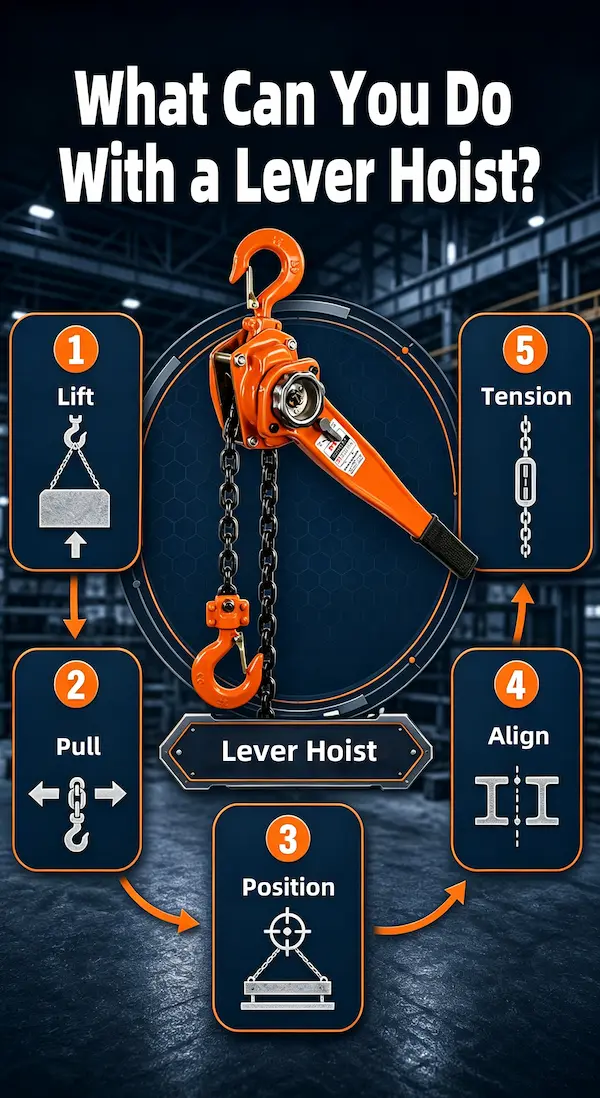
Lever hoists are commonly used when operators need to:
- Lift heavy machinery or components vertically.
- Pull structural members or equipment horizontally.
- Position components precisely during assembly.
- Tension cables, chains, or structural tie-downs.
- Secure heavy cargo and structural alignments.
Core Insight: A lever hoist is most valuable when portability, precise manual control, and multi-directional flexibility are more critical than high-speed continuous lifting.
Why Use a Lever Hoist?
Rather than replacing high-speed overhead cranes, lever hoists solve precise, local rigging challenges. Key operational advantages include:
- Portable: Compact and light enough to be carried directly to site locations in a toolbox or service truck.
- Manual Operation: Operates entirely without electricity, hydraulics, or compressed air supply.
- Precise Load Positioning: Ratchet-and-pawl braking mechanisms enable millimeter-by-millimeter load adjustments (“inching”).
- Compact Design: Engineered with low headroom to function efficiently inside cramped quarters and tight enclosures.
- Multi-Directional Flexibility: Unlike standard vertical-only chain blocks, lever hoists function smoothly at vertical, horizontal, or angled orientations.
Lever Hoist Applications in Construction
On active construction sites, structural components rarely land in perfectly aligned positions on the first attempt. Lever hoists bridge the gap between heavy mobile crane placement and final securing.
1. Steel Structure Installation
Lever hoists are vital for positioning and aligning steel components during installation. Riggers utilize them to pull heavy I-beams, trusses, and columns into alignment before bolting or welding.
2. Construction Maintenance
Used for temporary rigging adjustments, shifting formwork, or securing scaffolding components during ongoing site modifications.
3. Temporary Lifting Tasks
When permanent power infrastructure is not yet installed on site, a manual portable lever hoist provides an immediate, independent rigging capability.
Lever Hoist Applications in Machinery Installation
Industrial machinery installation requires high precision. Dropping or misaligning a multi-ton CNC machine, turbine, or press can lead to catastrophic damage.
- Machinery Positioning: Safely pulling or micro-adjusting equipment into exact floor anchor positions.
- Equipment Alignment: Mating motor flanges, gearbox shafts, and structural bases together.
- Plant Relocation: Facilitating delicate machinery moves within active manufacturing facilities.
The primary value proposition in machinery installation is precise manual control when an installer needs to “move a load just a tiny bit” without risk of overshooting.
Lever Hoist Applications in Maintenance & Repair
Routine plant maintenance demands tools that can be rigged quickly inside existing piping networks or structural bays.
- Equipment Maintenance: Holding pump casings or valve assemblies suspended while technicians replace seals or gaskets.
- Motor Removal: Pulling heavy electric motors out of tight machinery frames during overhaul.
- Pump Installation: Lowering and aligning sub-surface or in-line pumps into place.
- Mechanical Adjustment: Applying controlled force to realign binding drive systems or conveyor tracks.
Lever Hoists for Steel Structure & Rigging
Riggers rely on an industrial lever hoist for non-vertical force applications where standard chain falls cannot perform efficiently:
- Alignment: Pulling offset structural plates into flush contact.
- Tensioning: Tensioning guy wires, structural tie-rods, and temporary stay cables.
- Pulling: Dragging skid-mounted loads across shop floors or transport decks.
- Positioning: Securing complex rigging bridles in multi-point lifts.
Lever Hoist Applications in Workshops
In metal fabrication shops, shipyards, and machine repair facilities, lever hoists are everyday bench-side and bay-side tools:
- Welding Preparation: Clamping heavy plates or pipe sections tightly together prior to tack welding.
- Fabrication Assembly: Holding structural assemblies steady during fitting and drilling.
- Machine Repair: Disassembling press fits, shafts, or heavy covers safely.
- Short-Distance Material Handling: Shifting raw steel stock into cutting stations.
Lever Hoist Applications in Remote or Power-Free Areas
When operating off-grid, reliability in hazardous or remote sites is paramount. Because they require zero electrical power, lever hoists are critical for:
- Outdoor utility line maintenance and pipeline repair.
- Remote bridge and infrastructure construction.
- Field repairs on agricultural, mining, or forestry equipment.
- Emergency response and disaster recovery rigging.
Lever Hoist vs Electric Hoist: Which Application Is Better?
Choosing between a lever hoist and an electric chain hoist is not about finding which tool is universally superior, but identifying the right tool for your specific operational constraints.
| Application Factor | Lever Hoist | Electric Hoist |
|---|---|---|
| Portable Work | Excellent | Less Flexible |
| No Power Available | Excellent | Not Suitable |
| Frequent / Continuous Lifting | Medium (Manual Effort) | Excellent |
| Fast Lifting Speed | Limited | Excellent |
| Precise Load Positioning | Excellent | Good |
| Outdoor / Remote Work | Excellent | Depends on Power Source |
| Heavy Repetitive Lifting | Limited | Better |
Choose a Lever Hoist when: Portability is required, no electricity is present, micro-positioning/tensioning is needed, or lifting is periodic.
Choose an Electric Hoist when: Lifts are high-frequency, speed is essential, loads are handled repeatedly, and reliable power is available.
How to Choose a Lever Hoist for Your Application
Selecting the right hoist capacity and configuration prevents equipment damage and ensures jobsite safety. For a deep dive into specifications, read our technical guide: How to Choose a Lever Hoist.
When selecting a unit, evaluate the following operational factors:
- Load Capacity: Determine maximum Working Load Limit (WLL) needed (e.g., 0.75T to 9T).
- Lifting Height & Reach: Specify correct chain length for vertical lift or horizontal pull distance.
- Pulling Distance: Ensure adequate load chain length for long horizontal pulling setups.
- Working Environment: Consider exposure to outdoor weather, corrosive chemicals, or marine environments.
- Frequency of Use: Assess whether the task is occasional maintenance or continuous daily production.
- Available Space: Verify lever handle clearance and hoist body dimensions in cramped bays.
Lever Hoist Safety Tips
Adhering to strict safety protocols protects operators and equipment during manual hoisting operations.
Before Use
- Inspect the load hook, safety latch, chain, ratchet mechanism, and housing for wear, deformation, or cracks. (See our guide on Proper Hook Inspection).
- Verify the brake mechanism functions correctly under dead weight before initiating a full lift.
During Operation
- Never exceed the rated Working Load Limit (WLL).
- Avoid side-loading the hoist or tipping the hook tip; keep the load line straight.
- Review procedures to prevent Common Lifting Mistakes such as using the load chain as a sling wrap.
- Keep non-essential personnel clear of suspended or tensioned loads at all times.
- Operate the lever handle smoothly without adding pipe cheater bars for extra leverage.
Kylift Lever Hoist Solutions
Kylift manufactures heavy-duty industrial lever hoists tailored for demanding maintenance, construction, and manufacturing environments. Match your application to our recommended tonnage solutions below:
| Application Category | Recommended Capacity | Kylift Product Solution |
|---|---|---|
| Light Maintenance & HVAC Installation | 0.75 Ton / 1.5 Ton | Kylift Ultra-Compact Mini Series |
| General Construction & Structural Alignment | 1.5 Ton / 3.0 Ton | Kylift Standard Industrial Lever Hoist |
| Machinery Installation & Plant Maintenance | 3.0 Ton / 6.0 Ton | Kylift Heavy Duty Ratchet Series |
| Steel Structure Rigging & Heavy Pulling | 6.0 Ton / 9.0 Ton | Kylift High-Capacity Dual-Pawl Series |
| Remote Utility & Emergency Field Work | 0.75 Ton to 3.0 Ton | Kylift Portable All-Weather Series |
Frequently Asked Questions (FAQ)
Q1: What is a lever hoist commonly used for?
A lever hoist is used to lift, pull, position, and tension heavy loads manually in construction, maintenance, machinery installation, and structural alignment applications where precise load control and portability are essential.
Q2: Can a lever hoist be used for pulling horizontally?
Yes. Unlike standard vertical chain falls, a lever hoist is engineered with a mechanical brake and guide system that allows it to pull, tension, and position loads horizontally or at angled directions safely.
Q3: Can I use a lever hoist for machinery installation?
Absolutely. Lever hoists are ideal for machinery installation because they offer incremental manual control, allowing installers to move heavy equipment fraction-by-fraction into precise alignment.
Q4: Can lever hoists be used without electricity?
Yes. Lever hoists are 100% manually operated mechanical devices. They require no electrical power, hydraulics, or compressed air, making them ideal for remote, outdoor, or off-grid sites.
Q5: What is the main difference between a lever hoist and an electric hoist?
A lever hoist is manually powered, highly portable, multi-directional, and suited for low-frequency or high-precision positioning. An electric hoist requires power, provides faster lifting speeds, and is designed for high-frequency or heavy repetitive vertical lifting.
Q6: How do I choose the right lever hoist capacity?
Calculate the maximum weight of the load to be lifted or pulled, and select a hoist with a Working Load Limit (WLL) that exceeds your maximum anticipated load. Consider additional factors like head-room, pull distance, and environmental conditions.