
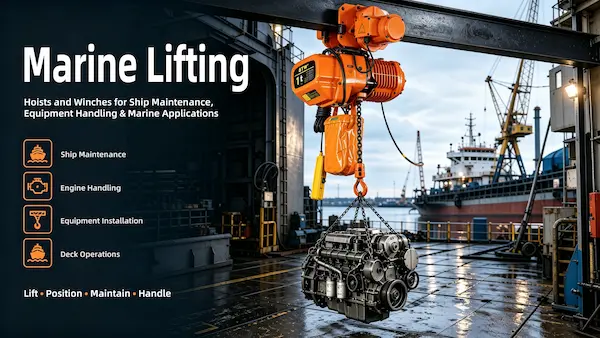
Marine Lifting: Hoists and Winches for Marine Applications
Marine lifting is not simply industrial lifting near water. Rather, the marine environment introduces stringent operational demands, requiring specialized equipment selection, robust corrosion protection, and disciplined maintenance protocols. Whether operations are conducted on an ocean-going vessel, a busy dockside, or an offshore platform, choosing the right marine lifting equipment is critical to ensuring operational safety and protecting high-value maritime assets.
Section 1: What Is Marine Lifting?
At its core, marine lifting refers to the precise lifting, positioning, and material handling of loads within maritime and offshore environments. Unlike standard warehouse or manufacturing operations, marine lifting encompasses diverse locations such as:
- Commercial Ships and Cargo Vessels
- Shipyards and Dry Docks
- Ports, Terminals, and Quaysides
- Offshore Platforms and Marine Maintenance Facilities
Frequent lifting tasks in these environments include maneuvering heavy marine engine components, position-setting auxiliary pumps, installing electric motors, moving piping assemblies, and handling deck-mounted machinery safely during routine maintenance or emergency repair.
Section 2: Common Marine Lifting Applications
To better specify the proper hoist or winch, marine lifting operations are typically categorized into five distinct application scenarios:
1. Ship Maintenance
Handling internal machinery such as water pumps, propulsion motors, control valves, and mechanical sub-assemblies inside confined vessel spaces.
2. Engine & Machinery Handling
Precision lifting and installation of main engine cylinders, heavy generator parts, and transmission components within engine rooms.
3. Equipment Installation
Securing structural auxiliary systems, heavy-duty pumps, and specialized electrical equipment during shipbuilding or refitting.
4. Deck Operations
Managing general cargo, positioning maintenance gear, and performing material handling on weather-exposed open decks.
5. Shipyard Operations
Facilitating structural hull block assembly, component alignment, and heavy machinery installation across dockyard facilities.
Section 3: Hoists and Winches Used in Marine Applications
Selecting the appropriate power source and mechanical configuration prevents equipment failure and ensures seamless material handling:
Hand Chain Hoists (Manual Chain Blocks)
Ideal for manual vertical lifting, temporary maintenance work, and areas lacking convenient electrical power supply. Highly portable and flexible, models like the HSZ Manual Chain Hoist or rugged HSC Manual Chain Hoist provide dependable manual control in tight spots.
Lever Hoists
Designed for multi-directional positioning, tensioning, pulling, and precision alignment during engine fitting and structural maintenance operations.
Electric Chain Hoists
Engineered for high-frequency, repetitive lifting tasks within dockyard workshops and onboard maintenance bays. Options like the Fixed Electric Chain Hoist provide steady lifting, whereas the Motorized Trolley Hoist allows smooth horizontal load transport along overhead monorails. For cramped vessel spaces, a Low Headroom Hoist maximizes usable hook path.
Mini Electric Hoists
Suitable for light-duty marine maintenance in covered, dry areas. Note: Standard mini electric hoists should not be treated as heavy marine-grade gear unless specifically configured with appropriate protection enclosures.
Electric and Mechanical Winches
Indispensable for horizontal pulling, mooring assistance, positioning deck cargo, and general offshore pulling tasks. Heavy-duty units such as the KCD Electric Winch provide powerful pulling capability for demanding industrial marine tasks.
Section 4: Why Is Marine Lifting Different?
Operating hoists or winches near seawater introduces severe environmental and physical challenges that accelerate machinery degradation:
- Saltwater & Salt Spray: Airborne salt aerosol acts as a severe corrosive agent, rapidly oxidizing exposed iron and steel surfaces.
- High Ambient Humidity: Moisture accumulation promotes corrosion inside electrical enclosures and mechanical gearboxes.
- Critical Corrosion Points: Hooks, load chains, wire ropes, structural fasteners, external housings, and motor brake surfaces require careful monitoring.
- Limited & Confined Working Spaces: Ship engine rooms and lower decks feature restrictive overhead clearances where compact equipment becomes advantageous.
- Weather & Temperature Exposure: Deck-mounted equipment faces relentless rain, wind, UV radiation, and rapid thermal cycles.
Section 5: Choosing Hoists for Marine Applications
Follow this systematic 6-step engineering selection process before specifying equipment:
Section 6: Corrosion Protection & Maintenance
Proper care extends hoist life substantially in coastal and offshore environments. Adhere to general maintenance principles:
- Regular Visual Inspection: Routinely inspect hooks, load chains, wire ropes, and fasteners for pitting rust, cracks, or mechanical wear.
- Thorough Cleaning: Wash down external equipment surfaces with freshwater to remove salt deposits, dirt, and industrial residue after use.
- Targeted Lubrication: Apply marine-grade lubricants to load chains, wire ropes, and open gears according to manufacturer maintenance schedules.
- Protected Storage: Store portable manual hoists in dry, ventilated, and sheltered areas when not actively deployed.
Section 7: Marine Lifting Safety
Maritime lifting operations involve heightened risks such as vessel dynamic roll, strong winds, wet decks, and confined spatial constraints. Always implement strict safety protocols:
- Never Overload: Strictly observe rated Working Load Limits (WLL).
- Pre-Operational Inspection: Verify brake response, latch integrity, and control responsiveness before every shift.
- Use Suitable Rigging: Utilize certified slings, shackles, and rigging hardware matching load weight.
- Secure Load & Clear Personnel: Ensure loads are balanced and exclude personnel from falling-object hazard zones.
- Follow Site Procedures: Adhere strictly to shipyard and marine safety permit protocols.
Section 8: Vertical Lifting vs. Pulling
| Operation Type | Primary Gear Used | Primary Function | Key Selection Factor |
|---|---|---|---|
| Vertical Lifting | Electric Chain Hoist / Hand Chain Hoist | Raising and lowering suspended loads vertically against gravity. | Fail-safe load mechanical brakes & certified chain safety factor. |
| Pulling / Positioning | Electric Winch / Lever Hoist | Incline pulling, horizontal dragging, and precise equipment alignment. | Drum wire capacity, freewheeling capability & directional pulling angle. |
Section 9: Marine Lifting Equipment: What Buyers Should Confirm
When requesting a quote for marine or dockyard applications, prepare the following specifications for your technical supplier:
- Load Weight: Exact maximum working weight.
- Lifting Height / Reach: Required vertical lift distance or drum wire rope storage capacity.
- Operating Environment: Specific location (Indoor workshop, quayside, open deck, offshore).
- Power Specification: Power supply availability (Voltage, Phase, Hz) or manual control preference.
- Duty Cycle: Intermittent maintenance use vs. continuous heavy production shift.
- Structural Interface: Overhead beam dimensions, trolley width, or deck mounting hole configurations.
Section 10: Can Standard Hoists Be Used in Marine Environments?
It depends on the specific product and marine environment. Standard industrial hoists may operate safely in dry, sheltered indoor shipyard workshops. However, deploying standard units on open ship decks or high-salinity offshore zones without specialized protection risks rapid corrosion, electrical shorts, and mechanical brake failure. For demanding marine or offshore environments, customers should always confirm equipment suitability with the manufacturer prior to installation.
Section 11: Kylift Marine Lifting Solutions
KYLIFT offers a versatile range of robust lifting and pulling equipment that can be evaluated and tailored according to the specific technical demands of marine, port, and shipyard applications:
- HSZ Manual Chain Hoist — Portable and durable for general maintenance tasks.
- HSC Manual Chain Hoist — Heavy-duty manual block built for rugged industrial use.
- Fixed Electric Chain Hoist — Dependable powered vertical lifting for dockyard facilities.
- Motorized Trolley Hoist — Smooth motorized horizontal traverse across monorails.
- Low Headroom Hoist — Engineered specifically for tight clearance vessel engine rooms.
- KCD Electric Winch — Robust pulling and material handling performance for marine projects.
Section 12: Final Checklist Before Ordering
Before issuing your purchase order, run through this quick checklist:
- ✔ Load Capacity Verified
- ✔ Lifting Height / Travel Distance Confirmed
- ✔ Application Mode Defined (Lifting vs. Pulling)
- ✔ Environmental Severity Assessed (Indoor vs. Salt Spray Deck)
- ✔ Power Source Parameters Checked (Voltage/Hz)
- ✔ Corrosion Protection Measures Evaluated
- ✔ Mounting & Beam Support Capacities Confirmed
- ✔ Applicable Marine Safety Requirements Met
Need Engineering Advice for Marine Lifting Equipment?
Get in touch with KYLIFT specialists to choose the right hoist, winch, or tailored material handling solution for your marine project.
Request a Quote / Contact Us