
Load Testing for Hoists: What Buyers Need to Know
A hoist is not ready for delivery simply because it can lift a load. It should be tested against defined requirements and manufacturer specifications.
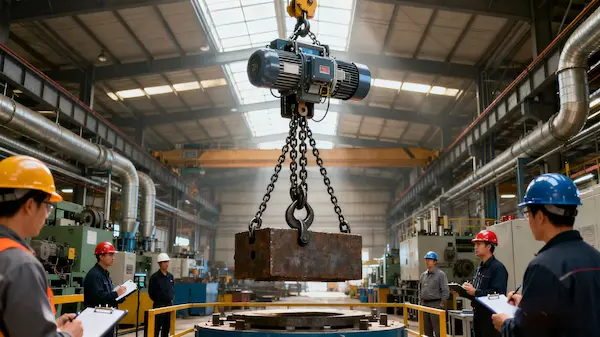
1. What Is Load Testing?
In industrial material handling, load testing refers to applying a specified test load to lifting equipment to verify that it performs as expected under defined test conditions[cite: 1, 9]. Rather than simply proving maximum weight capability, proper testing validates structural integrity, mechanical efficiency, and braking responsiveness under controlled parameters[cite: 1, 9].
It is crucial to understand that load testing is not merely about pushing equipment to its breaking limit or assuming “heavier is better.”
The test load, procedure and acceptance criteria should follow the applicable product standard, manufacturer specification and testing requirements. Different markets, machinery designs, and international standards govern specific proof limits and functional testing criteria[cite: 1, 9].
2. Why Is Hoist Load Testing Important?
For industrial buyers, distributors, and project managers procuring lifting equipment, verifying a supplier’s testing verification procedures is vital for four primary reasons[cite: 3, 9]:
- Verify Lifting Performance: Confirms that the hoist delivers its rated mechanical performance and operating parameters according to design standards.
- Identify Potential Problems Early: Detects mechanical anomalies prior to dispatch, such as brake slipping, abnormal gearbox noise, chain or wire rope binding, hook misalignment, or control responsiveness errors.
- Ensure Quality Control Integration: Serves as an essential milestone within factory-level quality control processes[cite: 3].
- Instill Buyer Confidence: Provides international purchasers with documented assurance that equipment is operational, verified, and ready for deployment upon arrival.
3. What Does a Hoist Load Test Check?
A thorough hoist load test extends far beyond checking if an electric motor runs or if a chain block moves[cite: 3]. Technicians evaluate several core subsystems under test conditions[cite: 3]:
- Lifting Function: Evaluates smooth upward and downward movement, motor torque, drive gear engagement, and overall mechanical operation.
- Holding & Braking Function: Verifies that the mechanical load brake or electromagnetic brake holds the test load securely without slipping or drifting under applicable test parameters.
- Load Chain & Wire Rope: Monitors chain line alignment, reeving smoothness, noise generation, and checks for abnormal deformation under tension.
- Hook Assembly: Inspects throat opening dimensions, safety latch engagement, rotation freedom, and structural integrity. For detailed hook evaluation parameters, refer to our Proper Hook Inspection Guide[cite: 3, 6].
- Control Systems: Evaluates start/stop responsiveness, push-button pendants, limit switches, and emergency stop features on electric lifting units[cite: 3].
4. The 6-Step Hoist Load Testing Process
Standardized testing procedures follow a structured workflow to maintain safety and repeatability[cite: 1, 9]:
STEP 1: Pre-Test Inspection
Verify product model, rated capacity, hook latch condition, chain/rope lubrication, brake mechanical alignment, controls, and overall physical condition prior to load application[cite: 3, 7].
STEP 2: Prepare the Test Area
Clear the lifting zone, inspect test rig calibration, prepare certified test weights, and establish safety exclusion perimeters.
STEP 3: Connect the Test Load
Rig the test weight correctly, ensuring balanced load distribution, vertical alignment, secure hook engagement, and stable rigging connections.
STEP 4: Lift Under Controlled Conditions
Operate the hoist through defined lifting and lowering cycles according to the specific product test procedure and governing standards.
STEP 5: Observe Performance
Monitor brake engagement, motor temperature, gear operation, structural deflection, load stability, and check for any abnormal noise or vibration.
STEP 6: Record & Inspect
Record all operational data, verify post-test component conditions, and conduct final quality sign-off before approving equipment for cleaning and export packaging[cite: 1, 4, 10].
5. What Is a Test Load?
When buyers evaluate manufacturing specifications, a common question arises: “What load ratio is applied during testing?”
It is essential to note that the appropriate test load depends on the product type, applicable standard (e.g., ISO, CE/EN, ASME), certification requirements, and manufacturer’s test procedure[cite: 1, 9]. Common test categories include:
- Proof Load Test: Verifies structural integrity and component strength using a designated test load specified by applicable manufacturing standards.
- Functional Test: Confirms smooth mechanical movement, limit switch activation, and control responsiveness.
- Rated Load Test: Demonstrates operational performance at 100% of the equipment’s nominal working load limit (WLL).
6. Static Load Test vs. Dynamic Load Test
Professional factory testing often incorporates both static and dynamic evaluations, depending on the equipment category:
Static Load Test
Focuses on evaluating equipment performance under a specified stationary load condition. This test evaluates structural yield resistance, frame rigidity, and brake holding efficiency without continuous vertical movement.
Dynamic Load Test
Evaluates equipment performance while lifting, lowering, or operating under specified conditions. Dynamic testing verifies motor power output, thermal behavior, gearbox smoothness, and brake stopping distance during active cycles.
7. Load Testing Different Types of Hoists
Testing methodology varies across different categories of lifting equipment within the KYLIFT product line[cite: 1]:
- Hand Chain Hoist: Focuses on manual pull-force requirements, mechanical pawl-and-ratchet brake holding, hand chain alignment, and smooth lifting operation. Learn more about our heavy-duty manual units like the HSZ Manual Chain Hoist and HSC Manual Chain Hoist[cite: 8, 11].
- Lever Hoist: Evaluates directional ratchet control, free-chaining mechanisms, pulling capability, and mechanical load brake security in horizontal and vertical orientations.
- Electric Chain Hoist: Evaluates electric motor thermal protection, electromagnetic brake response, precision chain guide feeding, and push-button control switches. Check out our range including the Fixed Electric Chain Hoist and Motorized Trolley Electric Chain Hoist[cite: 8, 11].
- Mini Electric Hoist: Tests compact motor performance, upper/lower limit switches, wire rope spooled alignment, and single/double hook lifting capacity configurations[cite: 5]. Explore options in our Mini Electric Hoist Overview Guide[cite: 5].
- Electric Winch: Winch testing requires dedicated setups tailored to specific applications such as line pull force, drum spooling, and horizontal pulling. For example, units like the KCD Electric Winch are tested based on pulling duty cycles, line speed, and hold-brake torque rather than standard vertical hoist setups alone[cite: 1].
8. What Happens If Equipment Fails a Test?
A rigorous quality system enforces strict protocols if an anomaly (such as abnormal noise, brake slippage, chain deformation, or erratic electrical control) occurs during testing[cite: 3]:
No hoist should ever bypass re-testing following adjustments or component replacement[cite: 1, 3, 9].
9. Load Testing Is Only One Part of Quality Control
While dynamic and static load tests provide vital performance verification, buyers should remember that load testing alone does not guarantee long-term operational reliability[cite: 1, 9]. Comprehensive quality control encompasses an end-to-end framework[cite: 1, 4, 10]:
- Incoming raw material & alloy steel inspection
- Precision component machining & heat treatment verification
- Sub-assembly & electrical wiring checks
- No-load functional performance testing
- Calibrated load testing (static & dynamic)
- Final visual inspection & nameplate verification[cite: 4, 10]
- Protective packaging & anti-rust application for maritime export[cite: 4, 10]
10. What Should Buyers Ask Their Hoist Supplier?
When sourcing lifting equipment from global manufacturers, asking the right questions helps ensure product quality and regulatory compliance[cite: 1, 9]. Consider using this verification checklist during procurement:
Buyer Verification Checklist:
- ✓ Is every hoist load tested before factory shipment?[cite: 1, 4, 10]
- ✓ What specific testing procedure and parameters are utilized?[cite: 1]
- ✓ What product standard or certification specifications apply (e.g., CE, ISO, ASME)?[cite: 1]
- ✓ Are individual test records maintained by serial/identification number?
- ✓ Can testing documentation or certificates be provided when required for project approval?[cite: 1]
11. How KYLIFT Tests Lifting Equipment
At KYLIFT, load testing is an integral part of our strict quality-control process for applicable manual hoists, electric chain hoists, and industrial winches[cite: 1, 4, 9, 10]. Operating as a direct factory manufacturer, we manage production quality through a clear six-stage internal workflow[cite: 1, 9]:
Following successful load verification, every unit transitions directly to our standardized 7-Step Export Packing Process to prevent rust and transport damage during international transit[cite: 3, 4, 10].
12. Load Testing Documentation
Depending on project requirements, contract scope, and regional standards, testing records for commercial lifting equipment may capture key traceability details[cite: 1]:
- Product Model & Serial / Identification Number
- Rated Capacity (WLL) & Applied Test Load
- Test Date & Procedure Reference
- Brake Performance & Functional Inspection Results
- Inspector Sign-off & Quality Remarks
Note: Specific test certificates or third-party documentation may be available depending on the product series, custom project scope, and customer requirements[cite: 1].
13. Final Takeaway
A reliable hoist is more than a lifting machine. It is an engineered system that should be properly specified, inspected, tested, and maintained throughout its service life[cite: 2, 3, 7].
Before buying a hoist, always verify:
- Capacity: Does the Working Load Limit match your operational requirements?[cite: 2]
- Application: Is the unit designed for workshop overhead lifting, low-headroom spaces, or horizontal winch pulling?[cite: 1, 8, 11]
- Testing & QC: Has the supplier verified brake function and lifting performance under test conditions?[cite: 1, 9]
- Documentation: Are specifications and compliance records available for your project needs?[cite: 1]
Looking for Reliable Lifting Equipment?
Tell us your required capacity, lifting height, application, and power supply. Our engineering team will recommend the optimal KYLIFT lifting solution for your project[cite: 2].
Request a Quote