
Warehouse Material Handling: Equipment Guide, Challenges & Selection Strategy
1. Warehouse Material Handling Overview
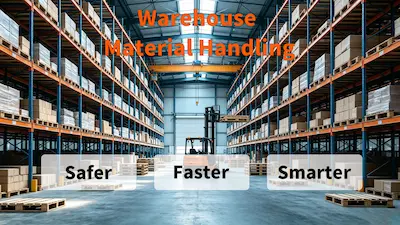
In modern industrial logistics, warehouse material handling represents the backbone of internal supply chain management. The rapid surge in e-commerce demands, global distribution networks, and just-in-time (JIT) manufacturing requires warehouses to operate with unprecedented speed and precision[cite: 538, 595]. As a result, commercial storage facilities are shifting rapidly from traditional manual labor toward semi-automated and overhead mechanized handling systems[cite: 538].
While floor-level transport relies heavily on forklifts and pallet jacks, vertical lifting and overhead positioning rely strictly on mechanical lifting machinery[cite: 595]. Implementing heavy-duty overhead lifting solutions—such as electric chain hoists and precision electric winches—allows logistics hubs to utilize vertical ceiling space, maintain high workflow throughput, and safeguard workers from severe fatigue and injuries[cite: 538, 601].
2. Common Operational Challenges in Modern Warehousing
Warehouse managers face complex operational hurdles that directly impact profitability and safety[cite: 445, 596]:
- Escalating Labor Costs: Over-reliance on manual heavy lifting increases operational expenditures and headcount overhead[cite: 445, 538].
- Workplace Safety Risks: Unassisted lifting of heavy dies, machinery, or dense goods frequently causes acute musculoskeletal injuries and chronic worker fatigue[cite: 445, 538].
- Bottlenecks in Handling Efficiency: Manual handling or slow, outdated equipment creates severe traffic delays during truck loading, unloading, and assembly line feeding[cite: 538].
- Tight Spatial Constraints: Narrow warehouse aisles and low overhead headroom often prevent traditional forklifts from reaching overhead storage bins or tight work bays[cite: 538].
- Aging Equipment Risks: Outdated or improperly maintained lifting blocks present severe mechanical brake failure hazards, risking costly cargo damage and site downtime[cite: 445, 467].
3. Material Handling Equipment Breakdown: Features, Pros & Cons
Choosing the right lifting machinery requires aligning product specifications with your warehouse’s duty cycle and layout[cite: 445, 538]. As a direct material handling equipment manufacturer, KYLIFT engineers recommend evaluating the following five primary lifting equipment categories[cite: 557, 595]:
A. Electric Chain Hoist
Ideal Applications: High-frequency vertical lifting in manufacturing plants, mold maintenance workshops, and high-density warehouse storage bays[cite: 445, 538].
- Fast, consistent lifting speed with dual-speed motor control[cite: 445].
- Equipped with double electromagnetic braking systems for absolute load holding safety[cite: 445].
- High lifting capacity range (0.5T to 20T) utilizing calibrated G80 alloy load chains[cite: 445].
- Requires continuous 3-phase or single-phase industrial power connection[cite: 559].
- Higher initial capital investment compared to manual blocks[cite: 505].
Learn more about specialized space-saving designs: Low Headroom Electric Chain Hoist Series[cite: 462, 595].
B. Manual Chain Block & Lever Hoist
Ideal Applications: Temporary lifting, outdoor loading bays without electrical infrastructure, maintenance rigging, and tight structural spots[cite: 403, 424].
- Zero electricity consumption; highly portable and lightweight[cite: 403].
- Robust automatic double-pawl mechanical brake system[cite: 403, 424].
- Extremely low maintenance cost[cite: 403].
- Slow lifting speed dependent on human physical labor[cite: 403].
- Unsuitable for high-frequency or multi-shift continuous operations[cite: 403, 538].
Check out our detailed guide: Hand Chain Hoist Daily Inspection Checklist[cite: 468].
C. Mini Electric Hoist
Ideal Applications: Small commercial workshops, light garage storage, automotive repair bays, and light material handling (≤1000 kg)[cite: 505, 538].
- Compact footprint, easily mounted on single-phase 110V/220V household/workshop power[cite: 505, 538].
- Highly affordable with flexible single/double hook lifting modes[cite: 505].
- Intermittent duty cycle rating; not designed for heavy 24/7 industrial shifts[cite: 505].
Explore compact lifting solutions: Best Mini Electric Hoist for Small Workshops Guide[cite: 505, 541].
D. Electric Winch (KCD Industrial Series)
Ideal Applications: Long-distance wire rope pulling, incline material hauling, construction scaffolding, and heavy horizontal load repositioning[cite: 559, 560].
- Extended wire rope drum capacity (up to 100m–150m)[cite: 560].
- Versatile mounting on ground foundations or overhead structural beams[cite: 560].
- Requires larger installation footprint than compact chain blocks[cite: 559, 560].
Compare winch specifications: KCD Heavy-Duty Electric Winch Range[cite: 560, 595].
E. Plain & Motorized Trolley
Ideal Applications: Enabling horizontal movement along I-beams or monorail crane systems when coupled with manual or electric hoists[cite: 595].
- Smooth lateral transport across long warehouse monorails[cite: 595].
- Adjustable flange width fitting standard I-beam and H-beam sizes[cite: 595].
- Must be accurately calibrated to track width to prevent derailment risks.
Explore options: GCT Manual & Geared Trolleys[cite: 595].
4. Key Benefits of Upgrading Your Warehouse Material Handling System
Investing in standardized, commercial-grade material handling machinery provides clear ROI across multiple facility metrics[cite: 445, 538]:
- Increased Overall Productivity: Electric hoists accelerate load cycle times by up to 300% compared to manual rigging, eliminating bottlenecking at dock loading zones[cite: 445, 538].
- Reduced Operator Fatigue & Injury Rates: Mechanized lifting eliminates manual physical straining, reducing workplace injury claims and compliance audit risks[cite: 445, 538].
- Lower Long-Term Operating Costs: Durable, factory-tested lifting gear minimizes unscheduled equipment downtime and cargo breakage costs[cite: 445, 596].
- Enhanced Operational Safety: Built-in limit switches, dual-braking mechanisms, and overload limiters ensure strict alignment with international ISO and OSHA safety codes[cite: 445, 600].
- Precise Load Positioning: Variable or dual-speed electric chain hoists allow micro-speed positioning, essential for delicate assembly and heavy mold handling[cite: 445].
5. Warehouse Lifting Safety Checklist & Maintenance Protocols
To ensure total workplace safety, warehouse managers should implement a mandatory pre-operational daily checklist[cite: 424, 467]:
| Inspection Zone | Key Checkpoints | Action Requirement |
|---|---|---|
| Load Chain / Wire Rope | Check for wear, gouges, missing chain lubricant, or twisted links[cite: 469]. | Lubricate daily; replace immediately if wear exceeds 10% tolerance[cite: 469]. |
| Lifting Hook & Latch | Inspect for throat opening stretch, cracks, and safety latch spring engagement[cite: 469]. | Never operate if the safety latch is missing or damaged[cite: 469]. |
| Braking System | Test brake engagement with a test load slightly raised off the floor[cite: 445]. | Verify zero slippage before proceeding with full-height lifting[cite: 445]. |
| Working Load Limit (WLL) | Verify capacity markings on both hoist body and hook block[cite: 424]. | Never exceed the rated tonnage under any circumstances[cite: 424]. |
6. How to Choose the Right Material Handling Equipment for Your Facility
Selecting the optimal equipment configuration requires analyzing five core operational criteria[cite: 403, 505]:
- Target Load Weight (Working Load Limit): Determine your average and maximum load weight. Always select a hoist capacity higher than your peak payload (e.g., choose a 2T hoist for 1.5T routine loads)[cite: 403, 505].
- Lifting Height & Clearance: Measure your ceiling height and beam obstruction. If headroom is limited, opt for a Low Headroom Hoist[cite: 462, 595].
- Operating Duty Frequency: For continuous, high-volume production lines, choose a 3-phase electric chain hoist with duty cycle ratings (FEM/ISO)[cite: 445, 559].
- Working Environment: Dust, moisture, outdoor exposure, or chemical fumes require IP55-rated enclosures, stainless steel chains, or explosion-proof motor housings[cite: 403].
- Power Supply Availability: Confirm whether your facility supports 380V 3-Phase power for industrial hoists or requires 110V/220V Single-Phase solutions[cite: 559].
7. Frequently Asked Questions (FAQ)
Optimize Your Warehouse Material Handling Workflow Today
Looking for custom factory-direct electric chain hoists, manual blocks, or complete warehouse lifting solutions? KYLIFT provides OEM manufacturing, international compliance certification, and global shipping[cite: 135, 136].
Request a Wholesale Factory Quote