
What is Load Chain Grade? A Complete Guide to Hoist Chain Selection & Safety
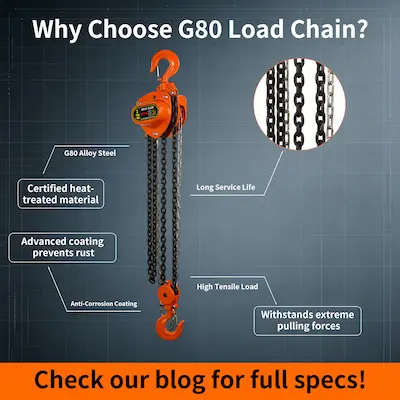
High-strength alloy load chains engineered for overhead lifting equipment and heavy-duty industrial applications.
In the material handling industry, safety and reliability depend entirely on the strength of your weakest link. Whether you operate a busy factory floor, a shipyard, or a construction site, selecting the correct load chain is vital to preventing sudden mechanical failures and costly downtime.
One of the most crucial technical specifications you will encounter when purchasing or maintaining a hoist is the load chain grade. But what does chain grade actually mean? How does Grade 80 differ from Grade 100 or Grade 30? In this guide, our engineering experts at KYLIFT break down everything you need to know about load chain grades, manufacturing standards, and how to choose the right chain for your electric chain hoists and manual chain blocks.
What Does Load Chain Grade Mean?
The chain grade is a standardized measure of the chain link’s material tensile strength. It is determined by calculating the ultimate breaking strength relative to the cross-sectional area of the wire used to form the chain link.
In simple terms, a higher grade number indicates a higher strength-to-weight ratio. A Grade 80 chain can lift significantly more weight than a Grade 30 chain of the exact same link thickness and dimensions.
- Grade 80 (G80): Tensile strength of approximately 800 N/mm².
- Grade 100 (G100): Tensile strength of approximately 1000 N/mm².
Breakdown of Common Chain Grades (G30 to G100)
Chains are manufactured for various industrial uses, ranging from basic transport binding to critical overhead lifting. Understanding these designations ensures you never accidentally use a non-rated chain for overhead applications.
| Chain Grade | Material / Treatment | Overhead Lifting Rated? | Primary Industrial Applications |
|---|---|---|---|
| Grade 30 (G30) | Low Carbon Steel | ❌ No | General purpose, tie-downs, agricultural barrier chains. |
| Grade 43 (G43) | High Carbon Steel | ❌ No | Towing, container securing, logging, truck tie-downs. |
| Grade 70 (G70) | Heat-Treated Carbon Steel | ❌ No | Heavy transport tie-downs, flatbed cargo control (Transport Chain). |
| Grade 80 (G80) | Heat-Treated Alloy Steel | ✅ Yes | Industrial hoists, rigging slings, heavy overhead lifting. |
| Grade 100 (G100) | Advanced Alloy Steel | ✅ Yes | High-capacity overhead lifting slings, compact high-output hoists. |
Why Only Grade 80 & Grade 100 Are Approved for Overhead Lifting
Safety regulations enforced by international authorities (such as OSHA, ASME B30.9, and EN 818 standards) strictly prohibit using chains below Grade 80 for overhead lifting.
The key reason lies in elongation and alloy ductility under extreme loads:
- Energy Absorption: Overhead lifting chains made from heat-treated alloy steel (G80 & G100) are engineered to stretch at least 20% before breaking under catastrophic overload. This visible elongation gives operators an essential early visual warning.
- Fatigue Resistance: Premium alloy chains withstand repeated stress cycles without suffering sudden brittle fractures.
Load Chain Grade Differences: Manual Hoists vs. Electric Chain Hoists
Not all Grade 80 chains are identical. Depending on whether your hoist is manually powered or driven by an electric motor, the exact metallurgical requirements for the hoist load chain specification differ:
1. Manual Chain Blocks (Hand Chain Hoists)
Manual hoists like the HSZ Series Manual Chain Hoist typically utilize standard Grade 80 alloy steel chains coated with black oxide, zinc plating, or DACROMET finish to resist corrosion during outdoors or job site operations.
2. Electric Chain Hoists
Electric hoists subject the load chain to continuous friction, high speeds, and heat generated while passing over the pocket wheel sprocket. Therefore, heavy-duty units like the low headroom electric chain hoist utilize surface-hardened alloy load chains (DAT / FEC grade alloy steel). These undergo special case-hardening treatments to deliver maximum surface wear resistance while retaining a ductile inner core.
How to Inspect and Maintain Your Hoist Load Chain
Even the highest grade alloy chain will degrade over time without proper routine maintenance. To keep your work site compliant with safety standards, implement the following steps:
- Check Chain Embossing: Certified lifting chains feature raised manufacturer and grade stamps (e.g., “G80” or “G10”) at fixed intervals along the links. If no grade marking is present, do not use it for overhead lifting!
- Inspect for Gauge Wear: Measure link thickness and pitch length regularly. If wear exceeds 10% of the original link diameter, immediately remove the chain from service.
- Proper Lubrication: Keep the chain clean and lubricated with non-corrosive industrial gear grease to minimize friction inside the pocket wheel.
For a detailed daily maintenance protocol, refer to our comprehensive guide on hand chain hoist daily inspection checklists.
Frequently Asked Questions About Load Chain Grades
Q1: Can I replace a Grade 80 load chain with a Grade 100 chain on my existing hoist?
A: Not without consulting the original manufacturer. While G100 is stronger, the chain pitch and link outer dimensions must match the pocket wheel sprocket inside the hoist drive housing precisely. A slight dimension discrepancy can cause jamming or damage to the sprocket wheel.
Q2: What is the difference between Transport Chain (G70) and Lifting Chain (G80)?
A: Grade 70 transport chain is heat-treated for high tensile strength, making it great for tie-downs on trucks. However, it lacks the ductility and heat treatment required for overhead lifting shock loads. G80 alloy chain is explicitly engineered and tested for overhead lifting.
Q3: How do I know if my KYLIFT hoist chain needs replacement?
A: Replace the chain if you detect visible elongation (stretching), cracks, gouges, severe rust pitting, or if link-to-link wear exceeds manufacturer tolerance limits.
Need Factory-Direct Lifting Hoists with Certified G80/G100 Chains?
At KYLIFT, all our manual and electric chain hoists are fitted with premium, strictly tested alloy load chains to meet international safety standards.
Contact KYLIFT Engineers for a Free Quote