
How We Test Every Hoist: Behind the Scenes of KYLIFT Quality Control
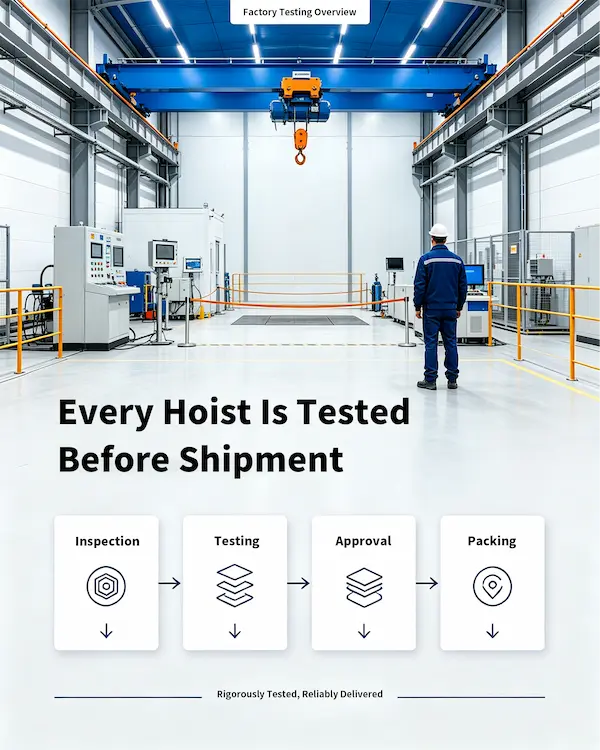
In heavy industrial lifting, equipment failure is never an option. Whether a hoist is operating inside a high-frequency manufacturing workshop, a construction site, or a logistics warehouse, a single mechanical or electrical breakdown can lead to costly operational downtime, severe equipment damage, or workplace injuries.
At KYLIFT (operated by Hebei Shoupai Hoisting Machinery Manufacturing Co., Ltd.), safety and engineering precision form the core of our operations. We believe true quality isn’t declared in marketing brochures—it is proven on the testing rig. Every single electric chain hoist, manual chain block, and heavy-duty electric winch leaving our facility undergoes rigorous multi-stage quality inspections before shipment.
Section 1: Why Hoist Testing Matters
Lifting equipment is subjected to repetitive mechanical stresses, high structural loads, and demanding environmental conditions. Factory testing serves as the critical line of defense between raw engineering and reliable field deployment.
🛡️ Preventing Accidents
Eliminates structural defects, faulty braking components, or chain weaknesses before equipment arrives on job sites.
⚡ Ensuring Performance
Verifies motor thermal endurance, lifting speeds, and precise dual-speed responsiveness under full loads.
⏳ Extending Lifespan
Reduces premature component wear by verifying gear alignment, lubrication seals, and bearing tolerances.
📜 International Compliance
Ensures full compliance with international standards including EN 14492-2, ISO 9001, ASME B30.16, and CE directives.
A non-tested or randomly sampled hoist represents a massive risk for procurement managers and HSE officers. That is why KYLIFT enforces a 100% individual testing protocol—meaning zero batch sampling shortcuts.
Section 2: Our Quality Control Process
Our quality management framework follows a strict closed-loop system from raw alloy steel receiving to final container loading. Below is the complete flowchart outlining how every hoist moves through our factory floor:
Section 3: Every Test We Perform (8 Core QC Modules)
To give complete transparency to our global distributors, OEM partners, and industrial clients, here is an in-depth breakdown of the 8 technical test modules conducted in our quality control laboratories:
Raw Material & Metallurgical Testing
Quality starts with raw inputs. We conduct spectrographic chemical analysis on incoming steel plates, forged steel hooks, and alloy chains. For our G80 calibrated load chains, tensile strength and elongation limit tests ensure the steel can withstand severe shock loads without brittle fracturing.
Component Precision & Hardness Inspection
Transmission gears, brake discs, and load sheaves undergo 3D coordinate measuring (CMM) and Rockwell hardness testing (HRC). Precision-machined helical gears ensure silent power transmission, while heat-treated brake pawls guarantee instant locking performance.
Assembly Verification & Gearbox Seal Check
During housing assembly, torque-calibrated wrenches secure high-tensile casing bolts. Gearboxes are filled with synthetic extreme-pressure grease and subjected to pressurized seal checks to prevent oil leakage in hot working environments.
No-Load Functional & Phase Testing
Before load application, the hoist runs without weight to check smooth chain payout, upper/lower limit switch activation, and button responsiveness on the pendant control. Phase error relays are checked on three-phase models to prevent motor reverse rotation.
Static & Dynamic Proof Load Testing
The core of our testing procedure. Every hoist is mounted on automated hydraulic test beds:
- Static Load Test: Applied at 125% to 150% of rated capacity to verify structural integrity and hook throat deformation limits.
- Dynamic Load Test: Executed at 110% capacity to evaluate electromagnetic brake engagement distance and motor thermal rise under load.
For detailed pre-use checklist guidelines, refer to our Daily Chain Hoist Inspection Guide.
Electrical Safety & Dielectric Testing
For our low headroom electric hoists and motorised trolleys, high-voltage insulation dielectric tests (up to 2000V) are conducted alongside grounding continuity tests to guard operators against electrical shock hazards.
Noise Level & Environmental Endurance
Decibel meters measure operational noise levels (maintained strictly below 80dB for electric models). Hoists designed for harsh environments undergo salt-spray coating thickness checks and IP55 water/dust resistance testing.
Final Visual Inspection & Certification
Each passed unit is stamped with a unique laser-etched serial number, fitted with heavy-duty safety latches, and issued its official KYLIFT Factory Test Certificate and CE compliance documentation.