
Construction Site Lifting: Equipment, Safety Tips and Best Practices
Why Construction Site Lifting Matters
On any active building site, thousands of tons of heavy raw materials and components must be moved continuously across vast vertical and horizontal distances. Everyday site operations require handling:
- Structural Steel Materials: Beams, rebar bundles, truss systems, and scaffolding frames.
- Piping & Utility Systems: Heavy steel pipes, HVAC ductwork, and conduit arrays.
- Heavy Equipment & Machinery: Generators, concrete mixers, pumps, and specialized tools.
- Precast Building Components: Concrete panels, staircases, and modular prefabricated units.
Relying solely on manual labor for heavy material handling creates massive bottlenecks. Manual lifting is extremely slow, physically exhausting, and carries high risks of chronic worker injury or fatal dropping accidents. Investing in professional, factory-tested construction lifting equipment dramatically accelerates construction timelines, minimizes labor overhead, and establishes a zero-accident working environment.
Common Lifting Challenges on Construction Sites
Unlike controlled indoor factory floors, construction job sites are dynamic, fast-evolving, and exposed to harsh outdoor elements. Equipment must overcome several severe site challenges:
Challenge 1: Heavy Dynamic Loads
Lifting massive steel girders or concrete slabs requires unyielding structural integrity. Equipment must withstand dynamic shock loading caused by wind gusts, sudden stopping, or load swaying during crane or trolley travel.
Challenge 2: Restricted Workspaces & Limited Headroom
Transferring materials between narrow floor levels, elevator shafts, or tightly packed scaffoldings demands compact lifting gear. In tight spaces, standard headroom hoists cannot achieve full hook lift height, requiring specialized low headroom chain hoists.
Challenge 3: Harsh Environmental Conditions
Outdoor sites expose hoists to heavy rain, abrasive sand/dust, extreme ambient temperatures, and muddy ground. Standard commercial lifting gear quickly degrades, rusts, or suffers electrical shorts without proper industrial sealing.
Challenge 4: Uncompromising Safety Regulations
Construction projects operate under stringent HSE (Health, Safety, and Environment) mandates. Equipment failures run the risk of catastrophic site injuries, structural damages, and severe regulatory shutdowns.
Common Equipment Used for Construction Lifting
Selecting the right machinery depends on load capacity, power access, and mobility needs on site:
1. Electric Chain Hoist
Ideal for construction workshops, structural assembly lines, and high-frequency vertical material transfers. A fixed type electric chain hoist or motorized trolley version delivers stable operation, fast hoisting speeds, and high duty-cycle ratings for continuous daily operations.
2. Electric Wire Rope Hoist
Specially engineered for high-rise building projects requiring extreme lift heights and heavy-tonnage capacity. Wire rope hoists offer high linear hoisting speeds through smooth drum winding mechanisms.
3. Manual Chain Hoist (Hand Chain Block)
Essential for temporary rigging, remote building zones, or areas without active electrical hookups. Portable manual blocks (such as HSZ/HSC manual chain hoists) allow site workers to perform precision positioning independently anywhere on site.
4. Electric Winch (KCD Series)
Designed for multi-angle material pulling, horizontal load positioning, and inclined ramp hoisting across scaffolding or building facades.
How Hoists Are Used on Construction Sites
Modular lifting hoists are applied across multiple core construction phases:
Application 1: Steel Structure Installation
Hoists suspend heavy I-beams, trusses, and prefabricated metal frameworks accurately in mid-air while structural ironworkers bolt and weld connections securely.
Application 2: Mechanical & HVAC Equipment Installation
Lifting heavy rooftop air handlers, chiller units, industrial boilers, and water pumps through floor openings or elevated maintenance platforms.
Application 3: Material Transfer Between Floors
Positioned on temporary overhead cantilever gantry beams or scaffolding frames, compact mini electric hoists rapidly transport concrete buckets, masonry bricks, and tools straight to upper floors.
Application 4: On-Site Scaffolding & Maintenance Work
Manual lever hoists and chain blocks assist in pulling scaffolding frames tight, aligning formwork panels, and supporting general field machinery maintenance.
Step-by-Step Safe Lifting Process
To eliminate operational hazards on site, every hoist operator and rigger must strictly execute this 5-step standard operating procedure:
- Step 1: Inspect Equipment Thoroughly: Prior to operation, conduct a complete pre-shift check. Follow our technical guide on proper hook inspection to check for throat deformation or cracks, inspect load chain links for wear, and confirm brake responsiveness.
- Step 2: Prepare & Balance the Load: Verify the exact load weight against the hoist’s rated limit. Identify the center of gravity, select certified rigging slings, and secure proper lifting points.
- Step 3: Secure the Working Area: Cordon off the lifting zone directly below the load with safety warning tape. Ensure zero unauthorized personnel are standing under suspended loads.
- Step 4: Lift Slowly & Smoothly: Tension the chain gradually to confirm balance before raising the load completely. Avoid sudden inching, violent jerky starts, or hazardous side pulling.
- Step 5: Position & Lower Materials Safely: Guide the load into its final destination using taglines. Lower the load gently until fully supported before detaching rigging hooks.
How to Choose Construction Lifting Equipment
Evaluating jobsite parameters before purchasing prevents machinery mismatch and equipment overload:
- Load Capacity (WLL): Always calculate your heaviest intended single load and select a hoist with a safe working capacity margin.
- Lifting Height: Verify total vertical distance from ground level to upper floors; ensure adequate load chain or wire rope drum length.
- Working Environment: For exposed outdoor jobs, specify hoists with IP55 rain covers, anti-corrosive chain finishes, and dust-proof enclosures.
- Operation Frequency: Choose heavy-duty M5/FEM 2m rated electric hoists for continuous multi-shift production, or manual hoists for light intermittent utility lifts.
- Power Supply Availability: Determine if site power provides 3-phase industrial voltage (e.g., 380V/415V), single-phase power (220V for mini hoists), or zero power (requiring manual chain blocks).
Construction Lifting Safety Tips
Worksite accidents stem from avoidable operational mistakes. Combining disciplined site management with regular maintenance eliminates major lifting hazards.
📋 Jobsite Safe Lifting Checklist
- Never Overload: Never exceed the rated load capacity under any circumstance.
- Inspect Hooks Daily: Check safety latches, hook rotation, and throat opening dimensions.
- Inspect & Lubricate Chains: Prevent dry friction wear by establishing a regular hoist chain lubrication maintenance schedule.
- Maintain Clear Safety Zones: Keep all non-essential personnel clear of suspended load paths.
- Avoid Common Mistakes: Eliminate dangerous habits by training staff on common lifting mistakes to avoid, such as side pulling or using worn chains.
- Mandatory PPE: Ensure operators wear hard hats, steel-toe boots, and high-visibility safety vests.
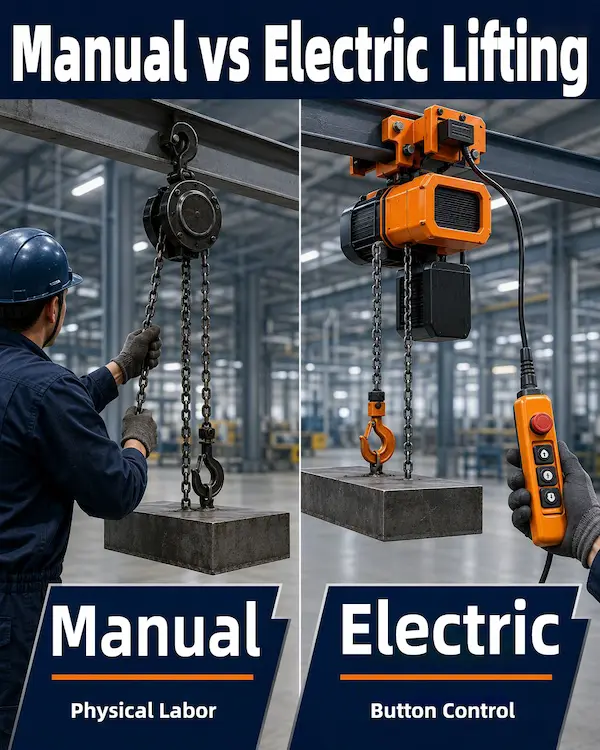
Manual vs. Electric Lifting on Construction Sites
Comparing performance attributes helps contractors select the right equipment mix for site efficiency:
| Feature / Metric | Manual Chain Hoist (Block) | Electric Chain Hoist |
|---|---|---|
| Lifting Speed | Slow (Hand-pulled) | Fast (Motor-driven) |
| Labor Requirement | High physical effort | Low (Push-button / Remote) |
| Usage Frequency | Intermittent / Spot maintenance | Continuous / High-frequency lifting |
| Portability & Setup | Extremely high, no power needed | Requires electrical connection |
| Operational Efficiency | Moderate | Very High |
| Ideal Site Application | Utility lifts, remote zones, scaffolding | Main material shafts, workshop bays |
KYLIFT Construction Lifting Solutions
As a global B2B manufacturing leader operated by Hebei Shoupai Hoisting Machinery Manufacturing Co., Ltd., KYLIFT engineers industrial-grade lifting solutions tailored for international construction environments:
- Full Product Range: Heavy-duty electric chain hoists (0.5T to 32T), portable mini electric hoists, G80/G100 manual chain blocks, and electric winches.
- Certified Quality Assurance: Every hoist undergoes 100% factory dynamic load testing (up to 125% rated capacity) in strict compliance with CE and ISO 9001 standards. Read more about how we test every hoist in our factory.
- Factory Direct & OEM Customization: Custom voltages, rain covers, low headroom configurations, and custom lifting heights available direct from our manufacturing plant.
- Export Packaging Standards: All equipment is protected with anti-rust oil coatings, waterproof wrapping, and heavy-duty reinforced plywood crates. Discover our complete hoist packing process for export shipment.
Equip Your Construction Site with Reliable Lifting Solutions
Get factory-direct B2B pricing, custom engineering support, and technical site consultations from KYLIFT hoist specialists today.
Contact KYLIFT Technical TeamFrequently Asked Questions (FAQ)
Q1: What equipment is used for construction lifting?
Common construction lifting equipment includes electric chain hoists for structural work, electric wire rope hoists for high-rise lifting, manual chain blocks for non-powered areas, electric winches for horizontal pulling, and mini hoists for scaffolding material transfers.
Q2: Can electric hoists be used outdoors on construction sites?
Yes. Outdoor electric hoists require IP55 enclosure protection, heavy-duty rain covers for motors and gearboxes, and sealed electrical control boxes to protect internal components against water and dust ingress.
Q3: How do I choose construction lifting capacity?
Calculate the total weight of your heaviest single material unit (e.g., steel beams or precast slabs) and add a safety margin of at least 20-25%. Ensure the hoist’s rated Working Load Limit (WLL) comfortably exceeds this calculated weight.
Q4: What safety checks are required before lifting?
Operators must perform a daily pre-operational inspection: check load hook latches, inspect load chains for wear or twist, test dual braking systems, clear the lift area of personnel, and verify proper sling attachment.