
How to Choose the Right Hoist Capacity for Your Load
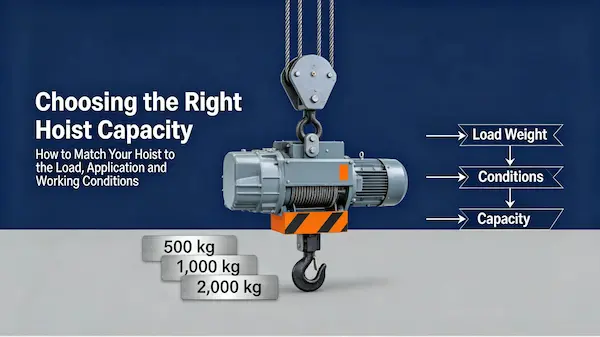
Selecting correct hoist capacity requires evaluating the total load weight, rigging hardware, and supporting structure.
Selecting the wrong overhead lifting equipment can lead to catastrophic equipment failure, costly workplace downtime, or severe safety violations[cite: 6]. A common pitfall among facility managers is simply looking at a item’s labeled weight and purchasing a matching hoist. In actual industrial operations, how to choose hoist capacity involves far more than matching two identical numbers.
What Does Hoist Capacity Mean?
Before diving into calculation steps, it is essential to clarify standardized terminology. In technical specifications, you will encounter terms like Rated Capacity, Rated Load, and Working Load Limit (WLL).
While terminology varies slightly depending on standards (such as ASME B30 or EN standards), hoist capacity refers to the maximum rated load the equipment is designed to lift under specified operating conditions. Standard capacities typically span common thresholds like 500 kg, 1 ton, 2 tons, 3 tons, up to 50 tons.
Regardless of standard or design margin, one absolute rule applies: Never exceed the manufacturer’s rated capacity under any circumstances during routine operations.
Step 1: Determine the Actual Load Weight
The foundation of accurate hoist load capacity assessment is knowing the precise weight of the object being lifted. Never rely on guesswork or casual visual estimation.
Method 1: Equipment Nameplate
Check the manufacturer’s physical metal nameplate stamped directly onto machinery, motors, or structural components.
Method 2: Technical Specifications
Consult official engineering documentation, CAD drawings, shipping manifests, or bill of materials (BOM).
Method 3: Scale / Weighing Systems
Use calibrated load cells, crane scales, or platform scales to verify exact weight prior to rigging.
Method 4: Calculated Estimation
Calculate volume multiplied by material density only when certified technical data or scales are unavailable.
Step 2: Include Below-the-Hook Lifting Accessories
One of the most frequent oversight errors in lifting planning is ignoring rigging weight. The hoist motor does not differentiate between the cargo and the gear holding it; it experiences the combined dead weight.
Suppose you are moving a 900 kg CNC component using a heavy spreader beam and rigging assembly weighing 50 kg. The actual load experienced at the bottom hook is 950 kg, bringing a 1-ton nominal threshold dangerously close once dynamic forces occur.
Always add the weight of all below-the-hook accessories:
- Rigging slings (synthetic webbing, wire rope, or chain slings)
- Shackles, eye bolts, and connecting links
- Spreader beams or lifting beams
- Lifting clamps and specialized grab tools
- Secondary lower block assembly or custom hooks
Step 3: Consider the Lifting Conditions & Duty Cycle
Operating context directly impacts how much weight a hoist can safely manage over time. Elevating performance factors differentiates standard procurement from professional equipment integration.
Lifting Height & Rope/Chain Weight
Extremely tall lifting heights add substantial weight in extended wire ropes or load chains, which loads the drum/spool additionally[cite: 5, 8].
Lifting Frequency & Duty Rating
A hoist lifting a 1-ton load once a week experiences significantly less mechanical fatigue than one executing 40 lifts an hour on an assembly line. Continuous duty requires higher ISO/FEM duty classifications (e.g., FEM 2M or 3M).
Environmental Considerations
Corrosive, humid, dusty, or high-temperature environments degrade lifting components. Hazardous outdoor exposure may require IP-rated enclosures or protective stainless steel components.
Load Movement Type
Determine whether your process involves purely vertical lifting, precise micro-positioning, or horizontal travel across a gantry using a Motorized Trolley Electric Hoist[cite: 3, 8].
Step 4: Choose the Rated Capacity (Practical Examples)
To visualize how to choose hoist capacity effectively, consider these three real-world scenario evaluations:
If the net weight plus accessories equals 500 kg and environmental/duty conditions are standard, a 500 kg or 0.5-ton rated hoist provides a fully compliant match.
Selecting a 500 kg unit is illegal and unsafe. While a 1,000 kg (1-ton) rated hoist theoretically covers 950 kg, if the operation requires heavy duty cycles or dynamic shock risks, stepping up to a 1.5-ton or 2-ton rating ensures longevity and prevents thermal trip issues.
Buying a 2-ton hoist seems sufficient on paper. However, you must carefully inspect duty cycles, hook throat limits, side-pull risks, and structural beam ratings before finalizing procurement.
Capacity Is Not the Same as Safety Margin
A widespread misconception in workshop management is: “My load is 1 ton, so if I buy a 2-ton hoist, my lifting operation is automatically safe.”
A larger hoist capacity does not automatically make a lifting operation safe. Oversizing the hoist motor does not compensate for:
- An underrated overhead I-beam or weak gantry frame
- Damaged or improper lifting hook safety inspection practices[cite: 6]
- Incorrect rigging angles that multiply sling tension
- Lack of operator training or improper rigging practices
Check the Lifting Structure & Mounting Points
A hoist is only as strong as what supports it. Installing a high-capacity hoist on an unverified structure creates extreme hazard conditions.
Prior to commissioning, certified structural engineers must verify load capacities for:
- Overhead I-beams, H-beams, and monorail tracks
- Portable or fixed gantry cranes
- Anchor bolts, ceiling mounts, and jib crane columns
This structural check is especially vital when installing heavy-duty Fixed Electric Chain Hoists, trolley systems, or heavy industrial winches[cite: 3, 8].
Choosing Capacity for Different Hoist Types
Different hoist configurations handle rated capacities uniquely across applications:
Manual Chain Hoists & Lever Hoists
Ideal for maintenance, utility work, or locations lacking electrical power. Options like the HSZ Manual Chain Hoist and HSC Manual Chain Hoist deliver rugged portable capacity for occasional heavy lifts[cite: 3, 8].
Electric Chain Hoists
Built for high-frequency industrial production lines and workshop floors. When overhead headroom is restricted, a Low Headroom Electric Hoist preserves critical lifting clearance while keeping rated capacity intact[cite: 3, 8].
Industrial Electric Winches
Important Note: Winch capacity cannot be directly compared to vertical hoist capacity. Winches are frequently engineered for pulling, horizontal towing, or inclined pulling. Line pull capacity varies depending on drum rope layers, slope angle, and friction factors.
Capacity and Lifting Height Relationship
Do not assume that lifting capacity remains isolated from lift height. As lift heights increase:
- Extra chain/rope weight adds to dead weight.
- Motor heat accumulation increases during longer duty cycles.
- Multi-fall reeving arrangements change line speed and mechanical balance.
Always confirm that the manufacturer’s specification covers both required capacity and total vertical lift distance simultaneously.
Common Hoist Capacity Selection Mistakes
Avoid these six critical mistakes during your equipment evaluation process:
- Selecting by payload weight only: Forgetting accessories and dynamic factors.
- Ignoring rigging hardware weight: Overlooking spreader beams and heavy slings.
- Neglecting structural support ratings: Mounting strong hoists on weak beams.
- Overlooking duty cycle needs: Using light-duty units in continuous 24/7 manufacturing.
- Operating above rated limits: Exceeding WLL under any circumstance.
- Assuming bigger always equals safer: Neglecting operator training and hook maintenance[cite: 6].
Quick Hoist Capacity Checklist
Pre-Procurement Hoist Selection Checklist
Kylift Can Help You Choose the Right Capacity
Unsure what size hoist you need for your facility? Don’t leave safety to chance. Share your application details with our engineering team, including load weight, lifting height, duty frequency, working environment, and voltage specs.
Contact Kylift Lifting Experts