OEM Customization for Hoists and Lifting Equipment: Process, Options and Requirements
In the global material handling sector, distributors, equipment rental companies, and regional brand owners face growing demands for market-specific adaptations. Selecting a qualified hoist manufacturer OEM supplier allows businesses to establish brand identity, meet regional safety certifications, and supply tailored equipment for specific lifting applications.
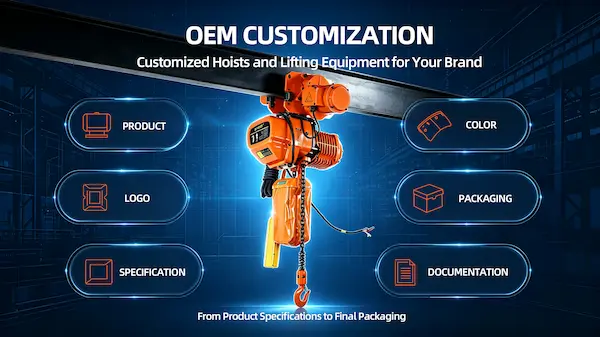
OEM customization (Original Equipment Manufacturer) means adapting a product design, component configuration, or production process to fulfill a customer’s specific technical, branding, and commercial requirements. Whether configuring custom electrical specifications for industrial overhead cranes or applying custom private labels on manual lifting blocks, structured OEM manufacturing ensures reliability without compromising structural safety.
Engineering Principle: OEM manufacturing is governed by strict mechanical tolerances and safety standards. While cosmetic elements (logos, colors, packaging) offer broad flexibility, mechanical alterations (load ratings, motor power, structural frames) depend strictly on existing model tooling, factory production capabilities, and minimum order requirements.
Why Choose OEM Customization for Lifting Equipment?
Standard off-the-shelf lifting products are engineered for generic applications. However, professional importers and regional distributors often require specialized product lines to stand out in competitive markets. Leveraging customized lifting equipment through OEM partnerships offers distinct commercial advantages:
- Market Differentiation: Offer exclusive product appearances, specialized motor ratings, or custom control systems that competitors do not stock.
- Brand Equity Building: Establish long-term customer trust by distributing high-performance hoists under your private label and unified brand aesthetics.
- Regional Standard Compliance: Ensure electrical configurations (voltage, frequency, control plugs) align precisely with local industrial grids (e.g., 220V 60Hz 3-Phase or 440V 60Hz).
- Application-Specific Adaptations: Modify lifting speeds, hook designs, or headroom dimensions to fit specialized overhead environments like cleanrooms, foundries, or construction sites.
What Can Be Customized? 1. Product Specifications
Engineered technical parameters form the core of a custom hoist project. Tailoring functional components allows equipment to operate safely under specialized working conditions.
Depending on the model base, functional options for OEM lifting equipment include:
- Rated Capacity: Standard configurations range from 0.5 Ton up to 32 Ton. Custom gearing or reeving options can be specified for dedicated heavy-duty cycles.
- Lifting Height & Chain/Wire Rope: Customized chain lengths (grade 80 or grade 100 alloy chain) and corrosion-resistant wire ropes tailored to high-rise construction or deep-shaft mining.
- Power Supply & Motor Configuration: Custom dual-voltage motors (e.g., 220V/440V), single-phase options, or specialized insulation ratings (Class F/H).
- Control Systems: Dual-speed magnetic contactors, variable frequency drives (VFD) for precision positioning, and custom wireless remote control interfaces.
- Mounting & Trolleys: Integration with low headroom manual push trolleys, motorized beam trolleys, or custom hook suspension fittings.
Important Note: Technical parameter customization is subject to structural engineering safety factors. Not every specification can be altered on standard frame sizes without re-tooling or full prototype load testing.
Brand Customization & Private Labeling
For brand owners and equipment dealers, visual consistency across private label products is critical. A reliable hoist OEM supplier provides comprehensive private labeling options that seamlessly integrate into your current product portfolio.
| Customization Category | Available Options | Application Purpose |
|---|---|---|
| Brand Logo | Screen printing, laser engraving, embossed die-casting, aluminum badges | Direct brand identification on hoist body and trolley plates. |
| Product Nameplate | Customized stainless steel / aluminum rivets plate with customized CE marks, serial numbering, and company details | Regulatory compliance, traceability, and localized service contact display. |
| Warning & Safety Labels | Multi-language hazard warnings, capacity indicators, load chart stickers | Ensures compliance with local job site safety codes (e.g., OSHA, CE, ANSI). |
| Brand Color Schemes | Custom powder coating, industrial enamel painting according to RAL color codes | Establishes distinct brand appearance and corrosion protection. |
Product Appearance & Color Options
Lifting equipment housing colors serve both functional and brand recognition purposes. High-visibility safety colors (such as safety yellow, orange, or signal blue) enhance site safety, while custom brand colors differentiate private label lines.
To ensure paint durability and uniform finish across batch production, industrial powder coating is applied to die-cast aluminum frames and steel covers. Color customization is executed based on standardized RAL codes, subject to minimum order quantities (MOQ) per production run.
OEM Packaging & Technical Documentation
Export packaging and documentation are crucial for international distributors to ensure products arrive safely and are ready for immediate market resale.
Custom Export Packaging
Proper industrial packaging prevents transit damage caused by oceanic moisture and rough handling. OEM packaging solutions include:
- Custom Wooden Cases & Cartons: Heavy-duty reinforced plywood crates or customized color printed cartons with brand logos.
- Shipping Marks & Barcodes: Customized outer carton printing, side marks, SKU barcode labels, and Amazon FBA/warehouse shipping tags.
- Inner Protective Cushioning: Molded foam shells, custom polyethylene inner bags, and VCI rust-inhibitor wrapping.
OEM Documentation Package
Distributing private-label machinery requires complete, professional paperwork. Standard OEM documentation packages consist of:
- Localized User Manuals: Operation and maintenance guides printed with your company contact information, brand logo, and localized safety languages.
- Factory Test Certificates: Individual proof-load test reports and factory quality inspection cards linked to individual product serial numbers.
- Commercial Documents: Customized packing lists and CE Declaration of Conformity documents reflecting the OEM brand structure.
How Does the OEM Process Work?
A structured workflow ensures that every custom electric hoist or manual block meets exact engineering specifications from initial concept to final dispatch. Below is the step-by-step OEM execution path:
Requirement Definition
The buyer provides technical specs, target capacity, working environment, voltage requirements, and branding design files (AI/PDF format).
Technical Feasibility Review
Engineering evaluates structural integrity, electrical compatibility, tooling requirements, and confirms feasibility for requested modifications.
Quotation & Business Terms
A complete commercial proposal is issued, detailing unit pricing, customization charges (tooling/artwork setup), MOQ, and delivery lead times.
Sample / Artwork Approval
2D/3D mechanical drawings, nameplate artwork proofs, and packaging mockups (or physical pre-production samples) are confirmed by the client.
Batch Manufacturing
Production begins following approved technical drawings, featuring integrated motor winding, component machining, and painting workflows.
Quality Control & Load Testing
Every customized hoist undergoes rigorous quality control, including electrical safety checks, dynamic over-load testing, and brake system verification.
What Information Does the Buyer Need to Provide?
To streamline engineering reviews and accelerate quotation response times, buyers initiating an OEM hoist project should prepare a detailed technical dossier. Providing accurate initial data minimizes redesign iterations.
- Target Product Line: Electric chain hoist, wire rope hoist, manual block, lever hoist, or industrial winch.
- Rated Capacity & Height: Maximum load requirement (e.g., 2 Ton) and required chain/wire rope lift height (e.g., 6 meters).
- Operating Power Supply: Exact operating voltage, phase, and frequency (e.g., 380V, 3-Phase, 50Hz).
- Application Environment: Duty cycle requirements, ambient temperature, outdoor exposure, or explosion-proof requirements.
- Branding Specifications: High-resolution vector artwork (AI, EPS, PDF) for logos, nameplates, and color codes (RAL).
- Expected Order Volume: Initial trial order size and projected annual batch quantities to evaluate tooling amortizations.
OEM vs. Standard Off-The-Shelf Products
Choosing between standard commercial models and customized OEM configurations depends on market urgency, budget, and brand strategy.
| Evaluation Factor | Standard Stock Product | OEM Customized Product |
|---|---|---|
| Lead Time | Fast dispatch (In-stock models ready for immediate export shipment) | Requires production cycles for artwork setup, painting, and custom assembly. |
| Minimum Order Quantity (MOQ) | Low or flexible MOQ (suitable for small trial orders) | Defined MOQ based on custom packaging, color mixing, and nameplate runs. |
| Branding & Identity | Factory standard factory labels and neutral packaging | Full private label integration (Custom logo, custom box, localized manual). |
| Technical Adaptation | Fixed factory specifications | Configurable lifting heights, dual voltages, special controls, and custom hooks. |
Understanding MOQ, Cost Factors & Lead Times
OEM project economics differ from standard procurement due to upfront setup and customization overheads:
- Minimum Order Quantity (MOQ): While standard hoists can be shipped in minimal units, brand-customized packaging and custom paint colors typically require minimum batch sizes to optimize production setup.
- Cost Drivers: Custom costs are dictated by artwork plate fees, specialized electrical component sourcing (e.g., Schneider contactors or telecrane wireless remotes), custom color mixing, and specialized wooden crate construction.
- Production Lead Times: Standard lead times range from 20 to 35 days, depending on component availability, pre-production sample approval, and final export quality inspection schedules. For details on how finished products are packed for global freight, explore our hoist packing and export shipment guide.
OEM Quality Control: Safeguarding Your Brand Reputation
When placing your brand name on imported equipment, product quality directly impacts your market reputation. Robust quality management protocols ensure that every customized hoist achieves consistent mechanical performance and long service life.
KYLIFT enforces strict, multi-stage quality assurance across all OEM production batches:
- Incoming Raw Material Inspection: Testing load chain tensile strength, motor copper wire insulation, die-cast aluminum housing integrity, and gear hardness.
- In-Process Assembly Checks: Verifying precision gear machining tolerances, limit switch alignment, and wiring circuit harness safety.
- 100% Full-Load & Dynamic Testing: Every electric and manual hoist undergoes static overload testing (up to 125% rated capacity) and dynamic operational braking tests.
- Final OEM Audit: Verifying label accuracy, nameplate serial alignment, cosmetic paint finish, manual inclusions, and structural package sea-worthiness. Learn more about factory inspection standards in our comprehensive guide to construction site lifting equipment and safety standards.
Kylift OEM & Customization Capabilities
KYLIFT provides tailored OEM solutions for global distributors, machinery dealers, and brand engineering partners. Backed by state-of-the-art manufacturing facilities, flexible assembly lines, and experienced mechanical engineers, we support specialized requirements across our primary product categories.
| Product Range | Customizable Options | Primary Applications |
|---|---|---|
| Electric Chain Hoists | Dual voltage, custom chain fall length, VFD speed control, wireless remote, custom housing color, low headroom configurations. | Industrial workshops, manufacturing facilities, high-duty material handling. |
| Manual Chain & Lever Blocks | Grade 80/100 chain options, overload protection devices, custom hand chain lengths, private label cover stamping, custom box packaging. | Power utilities, construction sites, field maintenance without power supply. |
| Electric Winches | Custom wire rope drum capacity, voltage specifications, custom control panels, specialized mounting frames, brand labels. | Warehouses, marine docks, mining installations, and heavy equipment towing. |
Start Your OEM Customization Project Today
Planning to expand your product line with customized hoists or private label lifting equipment? Provide your project requirements below, and our engineering team will prepare a technical feasibility review and competitive OEM quotation within 24 hours.
Ready to consult with our specialized engineers?