
Electric Winch Safety Tips: Inspection, Operation & Maintenance Guide
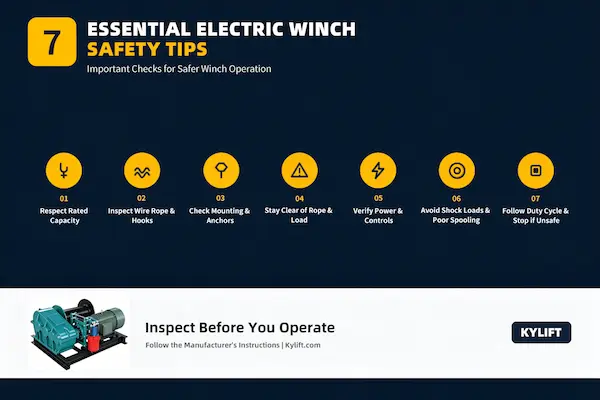
Electric winches are widely used for industrial pulling, equipment positioning, and certain lifting applications. However, improper installation, overloading, damaged wire ropes, or incorrect operation can lead to serious accidents. To ensure job site safety and optimal equipment efficiency, operators must adhere to strict technical guidelines from pre-operation checks to routine maintenance.
This comprehensive guide covers:
- Pre-operation safety checks and inspection checklists
- 10 essential rules for safe electric winch operation
- Common workplace hazards and prevention methods
- Equipment maintenance schedules and record-keeping requirements
Important Safety Disclaimer: Not all electric winches are designed for vertical lifting. Always confirm the manufacturer’s rated application, load limits, and operating instructions before use.
1. Why Electric Winch Safety Matters
Electric winches store and transfer immense mechanical energy under heavy tension. When operated without proper safety protocols or when subjected to unexpected stress, the risks escalate rapidly. Understanding potential failure modes ensures that operators and safety managers can intervene before a minor anomaly turns into a catastrophic failure.
Common Hazards in Electric Winch Operations
- Overloading: Exceeding the designed pulling capacity, leading to severe structural deformation, gear stripping, or wire rope failure.
- Wire Rope Failure: Utilizing worn, frayed, kinked, or incorrectly spooled wire ropes that snap under tension.
- Unstable Mounting: Inadequate foundation bolts or supporting structures that shift or tear away under dynamic loads.
- Electrical Hazards: Faulty wiring, poor grounding, or damaged insulation resulting in electric shock or short circuits.
- Uncontrolled Load Movement: Brake slippage or sudden shifting of loads due to improper load holding or shock loading.
- Personnel Exposure: Workers standing within the danger zone, snap-back path of tensioned wire ropes, or directly underneath suspended loads.
2. Pre-Operation Electric Winch Safety Checklist
Thorough inspection prior to starting work is the first line of defense against equipment failure. Review the structured checklist below before energizing your equipment:
| Inspection Item | What to Check |
|---|---|
| Winch mounting | Secure bolts, mounting frame, and supporting structural integrity |
| Wire rope | Broken strands, corrosion, kinks, crushing, and physical deformation |
| Hooks and connections | Surface cracks, wear, latch integrity, and secure pin connections |
| Electrical system | Power cables, grounding continuity, and pendant/remote control devices |
| Brake system | Correct holding operation according to manufacturer instructions |
| Rated capacity | Load within permitted rating for the specific configuration and rope layer |
| Drum winding | Proper parallel rope spooling and minimum retained safety wraps |
| Work area | Clear of unauthorized personnel, bystanders, and physical obstructions |
Never operate a winch if a safety-critical defect is detected. Remove the equipment from service until it has been inspected and corrected by qualified personnel.
3. 10 Essential Electric Winch Safety Tips
Tip 1 – Never Exceed the Rated Load Capacity
Always strictly comply with the manufacturer’s specified pulling force or lifting capacity limits. Keep in mind that effective pulling capacity decreases as layers of wire rope build up on the drum. Account for frictional resistance, incline angles, and pulley blocks. Never use trial overloads or forceful pulls to test whether a winch is powerful enough for a job.
Tip 2 – Inspect the Wire Rope Before Every Use
Examine the entire length of the wire rope for broken wires, corrosion, flattening, kinks, or bird-caging. Ensure the rope diameter is fully compatible with your winch drum and sheave grooves. Verify that end terminations and wedge sockets are secure. Replace damaged wire rope immediately according to manufacturer standards.
Tip 3 – Ensure Secure Winch Installation
The mounting foundation must be engineered to withstand maximum working loads and operational torque forces. Check all mounting bolts, backing plates, and structural attachment points. Confirm that the wire rope pull direction aligns with the winch design. Never rely on temporary, unverified clamping methods.
Tip 4 – Keep Personnel Clear of the Load and Wire Rope
Establish a strict safety perimeter around the operational zone. Prohibit workers from standing near taut wire ropes or within their potential snap-back recoil paths. Never allow personnel to stand or work under a suspended load. Unless specifically engineered and certified for passenger transport, never use industrial winches to lift people.
Tip 5 – Maintain Proper Wire Rope Winding
Prevent wire rope cross-winding, stacking, and loose spooling on the drum. Monitor the entry angle of the rope to ensure smooth layer distribution. Avoid sudden slack creation that can trigger damaging shock loads. Always preserve the manufacturer’s mandated minimum number of safety wraps on the drum.
Tip 6 – Avoid Sudden Starts, Stops and Shock Loading
Engage and disengage motor controls smoothly. Avoid jerky starts or sudden load applications that multiply static stress dynamically. Never attempt to free jammed equipment by repeatedly jarring or shock-loading the winch line. Select control systems designed for progressive acceleration.
Tip 7 – Check Electrical Connections and Controls
Verify that voltage, phase count, and frequency match the equipment specifications. Inspect power supply lines, control pendants, and enclosure seals. Confirm that grounding circuits and circuit breakers are functional. Test emergency stop buttons and limit switches before operation. Electrical repairs must only be performed by certified electricians.
Tip 8 – Follow the Rated Duty Cycle
Understand the motor duty rating (e.g., S3 intermittent rating). Avoid exceeding allowable run times and switching frequencies. Monitor the motor housing for abnormal thermal buildup. If thermal protection trips, investigate the underlying cause immediately rather than forcing repeated restarts.
Tip 9 – Use the Winch Only for Its Approved Application
Recognize that pulling winches and vertical lifting winches are engineered differently. Motor horsepower alone does not determine lifting suitability. Vertical applications demand dedicated load-holding mechanical brakes, specialized gearboxes, and failsafe safety mechanisms. For general insights on equipment performance, review our overview on electric winch advantages.
Tip 10 – Stop Operation Immediately if Abnormal Conditions Occur
Halt operation right away if you notice unusual noises, vibrations, rope slipping, erratic braking, motor overheating, unexpected load movement, or control failure. Lock out and tag out energy sources, and have qualified personnel inspect the system before resuming work.
4. Common Electric Winch Safety Mistakes to Avoid
Beyond the core operating rules, avoiding recurring operational errors prevents premature wear and costly job-site incidents:
| Common Mistake | Potential Risk |
|---|---|
| Ignoring rope damage | Sudden line snap and whipping hazard |
| Exceeding rated capacity | Catastrophic structural or gear failure |
| Improper mounting | Winch tearing away from base support |
| Operating with poor visibility | Uncontrolled movement and obstacle collision |
| Ignoring duty cycle | Motor burnout and electrical fire risk |
| Using a pulling winch for lifting | Unsafe load suspension and drop risk |
5. Electric Winch Maintenance and Inspection Best Practices
Routine Inspection and Maintenance
Inspection schedules should be tailored based on operating frequency, severity of the environment, and manufacturer guidelines rather than rigid monthly intervals:
| Frequency | Recommended Actions |
|---|---|
| Before each use | Visual inspection of controls, structure, and rope condition |
| Periodically | Brake wear check, fastener torque verification, electrical checks, and lubrication |
| After abnormal events | Comprehensive qualified inspection before returning to service |
| Manufacturer schedule | Detailed overhaul, component testing, and worn part replacement |
Maintenance Records and Operator Training
Maintain detailed logbooks of all inspections, repairs, and part replacements. Ensure all operators complete certified training programs before running industrial equipment. After any major repair or component replacement, conduct functional testing before returning the unit to active service. Unauthorized modifications to winch assemblies are strictly prohibited.
6. How to Choose a Safer Electric Winch for Your Application
Safety begins long before installation—it starts at the procurement stage. When sourcing industrial pulling or lifting equipment, evaluate these core parameters:
- Rated pulling or lifting capacity
- Approved application (pulling vs. lifting)
- Brake holding torque and automatic mechanical braking
- Wire rope specifications and drum capacity
- Enclosure protection ratings (IP rating) and electrical controls
- Motor duty cycle and thermal protection
- Mounting compatibility and environmental adaptability
For more detailed parameter selection, refer to our 220V Electric Winch Selection Guide.
| Information | Customer Requirement |
|---|---|
| Application | Pulling / Approved lifting |
| Required load | ___ kg |
| Travel / Pull distance | ___ m |
| Power supply | ___ V / Phase / Hz |
| Operating frequency | ___ |
| Installation environment | ___ |
Need an Electric Winch for Your Project?
Share your application and technical requirements with Kylift. Our engineering team can help you identify a suitable winch configuration tailored to your operational needs.
Request a Quote7. Frequently Asked Questions About Electric Winch Safety
Can an electric winch be used for vertical lifting?
Not unless it is explicitly rated and certified for vertical applications. Standard utility winches lack the specialized dual-braking systems and safety factors required for overhead lifting.
How often should an electric winch be inspected?
Pre-operation visual checks must occur before every use. Periodic in-depth inspections should follow the manufacturer’s maintenance schedule adjusted for work intensity and environmental wear.
What are the signs of a damaged winch wire rope?
Broken wires protruding from strands, severe rust, localized crushing, kinks, and twisted deformities indicate that the rope has compromised structural integrity.
What happens if an electric winch is overloaded?
Overloading places excessive stress on gears, motors, brakes, and mounting bolts, risking sudden mechanical failure and uncontrolled release of the load.
Can an electric winch operate continuously?
No, standard industrial electric winches are designed for intermittent duty cycles. Exceeding running time limits causes overheating and permanent insulation breakdown.
Conclusion: Safe Winch Operation Starts with Proper Selection and Maintenance
Ensuring safety during electric winch operations requires a disciplined approach: select equipment specifically engineered for your application, perform rigorous pre-operation inspections, adhere strictly to rated load limits and duty cycles, and follow scheduled maintenance intervals. By addressing potential hazards proactively and stopping work immediately upon discovering anomalies, you protect both your personnel and your equipment investment. Reach out to Kylift today to discuss your next industrial lifting or pulling challenge.