
Hoist Overloading Risks: Causes, Consequences and Prevention
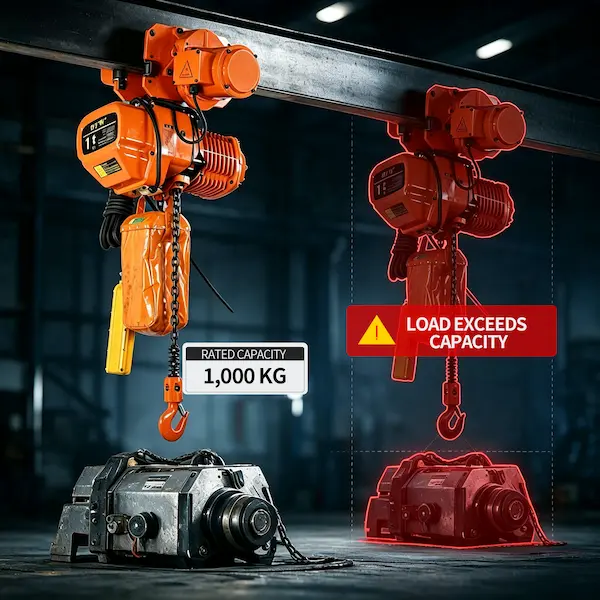
In heavy material handling, maintaining overhead lifting equipment safety is paramount to protecting operational workflow and workforce integrity[cite: 7]. Among operational hazards, operating an overloaded hoist remains one of the primary causes of catastrophic component failure, sudden brake slips, and costly facility downtime[cite: 7].
Rather than relying solely on accident case studies, establishing a systemic engineering understanding of why overloading occurs, how it stresses mechanical assemblies, and how to prevent it is essential for modern plant management.
Core Safety Mandate:
• Never exceed the rated capacity of a hoist.
• The rated capacity is a operational limit — NOT a target.
1. What Is Hoist Overloading?
At its core, hoist overloading means applying a load that exceeds the equipment’s official rated capacity (Working Load Limit / WLL) or otherwise operating outside its specified operational limits.
Simply put: If an industrial hoist is rated for 1,000 kg, it must never be treated as a device capable of safely lifting over 1,000 kg under any practical circumstances. Achieving true safe working loads requires evaluating the complete system, taking into account:
- Net Load Weight: The precise mass of the direct cargo.
- Lifting Accessories: Weight contributed by slings, shackles, clamps, and spreader beams[cite: 1, 3].
- Lifting Configuration: Dynamic forces created by angles, off-center geometry, or multi-point reeving.
- Supporting Structure: Overhead gantry, crane runway, or structural I-beam load limits[cite: 1].
- Manufacturer Specifications: Duty cycles, environmental limits, and operational parameters[cite: 1, 4].
2. Why Does Hoist Overloading Happen?
Overloading rarely stems purely from operator carelessness. In practice, operational pressures and systemic oversights contribute heavily to overloaded hoists:
1) Unknown Load Weight
Operators frequently guess payload weights on unweighed machinery, fabricated structures, or bulk storage containers without verifying shipping documentation or scale data[cite: 1].
2) Choosing the Wrong Capacity
Improper procurement decisions often lead to undersized units[cite: 3]. If a facility repeatedly lifts loads nearing maximum threshold, selecting an under-rated unit causes chronic overloading. (Learn more on how to choose hoist capacity)[cite: 3].
3) Ignoring Rigging Accessories
Calculating load weight while excluding heavy below-the-hook rigging gear—such as motorized spreader beams, heavy-duty alloy lifting clamps, or multi-leg chain slings—silently pushes total payload past rated capacity[cite: 1].
4) Dynamic Payload Changes
Tanks, hoppers, or structural components holding residual materials, trapped water, or internal sub-components increase in total weight during movement unexpectedly.
5) Attempting to Free a Stuck Load
A critical operational mistake occurs when a load is anchored, bolted down, or snagged on surrounding infrastructure. Operators mistakenly believe applying additional motor force will dislodge the obstacle, subjecting the entire frame to exponential force multipliers far exceeding equipment ratings[cite: 7].
6) Improper Lifting Configurations
Off-center lifting, dynamic shock loads from sudden acceleration, and side pulling alter stress vectors, subjecting components to localized forces beyond structural design limits[cite: 7].
3. What Can Happen When a Hoist Is Overloaded?
Operating beyond rated capacity induces immediate and cumulative degradation across critical structural and mechanical sub-assemblies:
Mechanical Damage
- Gear Damage: Over-torque strips spur gears, shears pinion teeth, and causes gearbox casing fractures.
- Brake Failure: Excessive loads exceed the static friction threshold of load brakes, leading to thermal glazing, slippage, or sudden load dropping[cite: 7].
- Chain & Wire Rope Deformation: Load chains stretch beyond elastic limits, causing pitch distortion that jam pocket wheels; wire ropes suffer core collapse and birdcaging[cite: 7].
- Hook Strain: Throat openings stretch open beyond allowable safety margins, rendering latches ineffective[cite: 6, 7].
Electrical & Motor Stress
- Motor Overheating: High amperage draw under heavy load breaks down insulation, leading to short circuits and burnt stators.
- Electrical Component Fatigue: Contactors, relays, and power supply cables face arc damage and premature failure under high current draw.
Structural & Stability Risks
- Micro-Cracking & Structural Wear: Load frames, side plates, and suspension pins suffer cumulative material fatigue and plastic deformation.
- Load Instability & Dropping: Unbalanced or failing components trigger uncontrollable load shifting, threatening personnel below[cite: 7].
- Supporting Structure Failure: Overloading transfers excessive bending moments into building I-beams, monorail tracks, and overhead crane bridges[cite: 1].
4. The Hoist Is Not the Only Thing at Risk
A foundational principle in lifting operations is clear: The lifting system is only as strong as its weakest component.
Every element along this load path must be certified for the intended duty. For example, pairing a 2-ton electric chain hoist with a 1-ton rated webbing sling or attaching it to an uncertified 1-ton overhead beam compromises the entire system, creating immediate hazards regardless of hoist capability[cite: 1, 8].
5. Warning Signs That Require Immediate Attention
While these symptoms can also stem from routine wear or lack of lubrication, any of the following warning signs require stopping operations for immediate technical evaluation[cite: 10]:
- Abnormal Mechanical Noise: Severe grinding, clicking, or high-pitched squealing inside the gearbox or load sheath[cite: 2].
- Slow or Irregular Lifting Speed: Motors struggling, stuttering, or failing to maintain constant speed during elevation.
- Brake Slippage or Drifting: The payload slowly drifts downward after releasing control buttons[cite: 7].
- Chain / Rope Anomalies: Visible kinking, binding, pitch elongation, or severe gouging[cite: 6, 7].
- Hook Throat Deformation: Noticeable stretching of the hook throat or unseated safety latches[cite: 6, 7]. (Refer to our hoist hook inspection guide)[cite: 6].
- Excessive Motor Thermal Output: The motor housing becomes excessively hot to the touch or emits burning odor/smoke.
6. Never Use a Hoist to Free a Stuck Load
Attempting to yank or pull stuck components is a severe hazard in field operations[cite: 7]. When a load resists movement, applying continuous hoist force generates exponential dynamic load multipliers.
CORRECT PROCEDURE: Stop immediately ➔ Identify obstruction ➔ Release/reposition load safely ➔ Inspect lifting gear
7. How to Prevent Hoist Overloading
Preventing overloading requires disciplined operational protocols before making any lift[cite: 2, 7]:
- Step 1: Know the Load Weight: Verify exact weights using verified scale tickets, blueprints, or calibrated load cells[cite: 1].
- Step 2: Select Correct Capacity: Ensure the unit’s rated capacity comfortably covers net load plus dynamic factors[cite: 1, 3].
- Step 3: Include Below-the-Hook Accessories: Factor in all slings, shackles, spreader beams, and grabbing tools[cite: 1, 3].
- Step 4: Perform Pre-Use Inspection: Inspect hooks, safety latches, load chains, wire ropes, and control pendants before every shift[cite: 6, 7].
- Step 5: Strictly Adhere to Manufacturer Instructions: Operate within specified duty cycles, ambient thermal limits, and lifting speeds[cite: 1, 4].
- Step 6: Stop Immediately When Conditions Change: Halt operation if unusual resistance, weird sounds, or adverse weather events occur[cite: 2, 7].
8. Capacity Selection Matters
Proper engineering capacity selection serves as the primary barrier against overload hazards[cite: 3]. Rather than choosing equipment purely by cargo weight, evaluate total system operational requirements[cite: 1].
Consider this practical calculation:
- Target Machinery Weight: 900 kg
- Spreader Beam & Heavy Rigging: 50 kg
- Total System Payload: 950 kg
In this scenario, utilizing a 500 kg capacity hoist is an immediate safety violation[cite: 5]. While a 1,000 kg (1 Ton) unit covers the static 950 kg load, high lifting frequencies or dynamic conditions may warrant selecting a higher capacity or heavier duty cycle unit to maintain appropriate operational buffers[cite: 1, 3].
9. Overloading Risks Across Different Hoist Types
Different lifting equipment categories exhibit distinct vulnerability characteristics under overload conditions:
Hand Chain Hoist (Manual Block)
Operators applying excessive force on hand chains under load stress internal load brakes and deform hand chain wheels, increasing risk of mechanical lockup or chain fracture[cite: 2, 7, 8].
Lever Hoist (Ratchet Puller)
A dangerous mistake is using extension pipes (“cheater bars”) on operating levers to gain extra leverage[cite: 7]. This bypasses structural design thresholds and causes immediate handle shearing or gear collapse.
Electric Chain Hoist
Overloading electric chain hoists triggers thermal overload relays, accelerates friction disc wear in load brakes, and stretches alloy load chains[cite: 3, 7, 8].
Mini Electric Hoist
Compact PA series mini hoists are designed for light-duty applications[cite: 5, 8]. Operating compact units near or beyond rated limits causes rapid motor burnout and gearbox wear[cite: 5]. (See our mini electric hoist overview)[cite: 9].
Electric Winch
It is vital to note that horizontal winch pulling capacity differs from vertical lifting rating[cite: 1, 8]. Winch capacity changes across drum rope layers, and using pull winches for overhead hoisting risks structural failure[cite: 1, 8].
10. What to Do After an Overload Event?
If a hoist experiences an intentional or accidental overload event, follow these steps strictly:
DO NOT: Continue operating the hoist simply because it appears undamaged externally.
DO FOLLOW THIS PROTOCOL:
Overload forces can induce internal fatigue micro-cracks, gear tooth hairline fractures, or brake disc degradation that remain invisible without professional disassembly or non-destructive testing (NDT)[cite: 1, 8].
11. Load Testing After an Overload
Following corrective maintenance or structural overload evaluation, the lifting gear must undergo formal proof testing following manufacturer guidelines and applicable standards before returning to service[cite: 1, 8].
12. Kylift Quality & Safety Commitment
At KYLIFT, safety is integrated into engineering, production, and quality management processes[cite: 1, 3, 8]. KYLIFT manufactures heavy-duty electric chain hoists, manual blocks, and winches adhering to precise tolerances and quality standards[cite: 1, 3, 8].
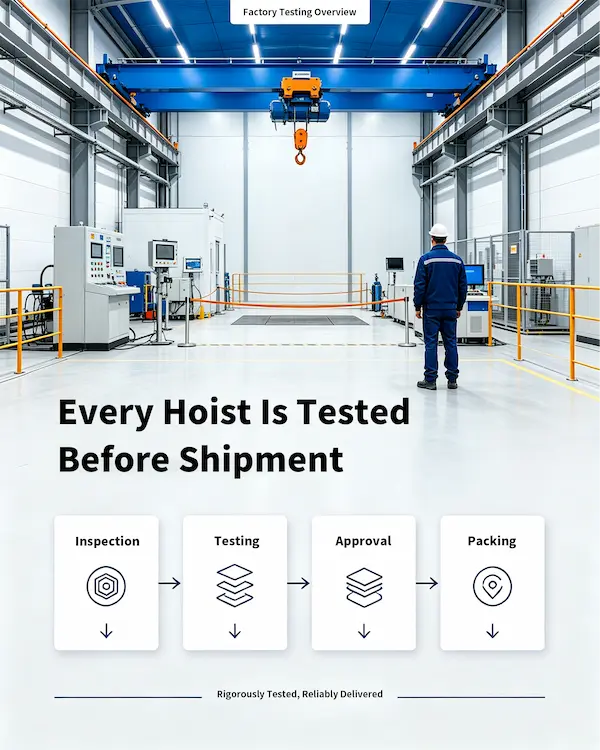
To deliver reliable performance on job sites worldwide, our manufacturing control flow incorporates stringent verification phases[cite: 1, 3, 8]:
While robust equipment engineering offers essential operating reliability, proper equipment selection, operational training, and routine maintenance remain crucial to maintaining long-term safety[cite: 1, 3, 7].
13. Pre-Lift Safety Checklist
Complete this checklist before performing any overhead lifting operation[cite: 2, 7]:
- Know exact load weight (Cargo + Accessories)[cite: 1].
- Confirm total payload does not exceed hoist rated capacity[cite: 1, 7].
- Inspect load chains/wire ropes for wear, kinking, or deformation[cite: 6, 7].
- Check hook throat opening and confirm safety latch functions properly[cite: 6, 7].
- Inspect slings, shackles, and below-the-hook rigging gear[cite: 1, 7].
- Verify overhead structure and trolley are rated for the total weight[cite: 1].
- Ensure load path is clear of obstacles and personnel[cite: 2].
- Confirm vertical lifting alignment to prevent side pulling[cite: 7].
- Halt operation immediately if abnormal noise, motor drag, or brake slip occurs[cite: 2, 7].
Need Help Choosing the Right Hoist?
Avoid capacity risks and optimize your facility’s safety. Tell us your load weight, lifting height, application, duty frequency, and power supply. Our technical engineering team will assist in configuring the optimal lifting solution for your application[cite: 1, 3, 4].
Request a Custom Quote